
We earn a commission if you buy through these links. Learn more
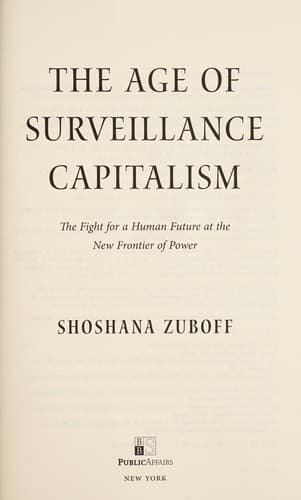
The Age of Surveillance Capitalism
Zuboff gives the clearest vocabulary yet for how tech firms turned everyday behavior into raw material for prediction, but it demands patience with a very long, repetitive argument.
What It's About
The Age of Surveillance Capitalism is Shoshana Zuboff's attempt to name and explain a new economic logic, one in which the raw material is the behavioral data people generate just by living online, and the product is a forecast of what they will do next. She traces how this model grew out of Google's search business in the early 2000s and then spread through the wider technology industry, reshaping advertising, platforms, and the devices people carry.
The book is less an investigative exposé than a long theoretical argument. Zuboff builds her vocabulary slowly, defining terms, tracing corporate history, and comparing the new economy with earlier forms of industrial capitalism. Expect a deliberately wide frame, with frequent detours into philosophy, political theory, and the history of ideas about freedom and markets.
Reading it feels like sitting through a seminar with a very committed lecturer. Some passages are gripping, especially where she describes how companies learned to nudge behavior and how users rarely see the trade they are making. Others are slow going. The payoff is a language for discussing the business model, rather than a set of practical steps for protecting your privacy.
Read this if you…
- want a detailed framework for talking about tech business models
- are willing to read a long, repetitive argument for the big picture
- already know the basics of data collection and want the deeper critique
Skip it if you…
- want practical steps to lock down your privacy settings
- need a brisk, plain-language read or a book built around hard data
Key Ideas
- 1
Behavioral surplus as the core raw material
Zuboff's central claim is that companies gather far more data than they need to improve a service, and the leftover behavioral surplus becomes the input for predicting what people will click, buy, or believe. The surplus is the thing being sold, even when the user thinks they are getting a free search or social feed. She argues this is a distinct economic logic, not just a sloppier version of traditional advertising.
- 2
Prediction products traded in markets
Once behavior is converted into forecasts, those forecasts are sold to business customers who want to influence outcomes, most often advertisers. Zuboff argues that the real customers are those seeking certainty about future behavior, while users are the source of the material rather than the client. She frames this as a shift from earlier promises of serving people toward profiting from predicting and shaping them.
- 3
Origins in search and the early 2000s
Zuboff locates the turning point in the search company's discovery that data collected as a byproduct of use could be monetized for ad targeting. She presents this as a choice that other firms later copied. Her historical account is detailed on this point, but readers should weigh it as her interpretation of events rather than settled fact.
- 4
Instrumentarian power and quiet steering
Zuboff coins the term instrumentarian power to describe influence that works through constant measurement and subtle nudging rather than force or ideology. Her worry is less that people are watched than that they are steered, with individuals gradually losing the sense of choosing for themselves. The idea is abstract, and her examples do most of the work in making it concrete.
- 5
Lived experience as free raw material
She argues that companies treat ordinary life, including movements, conversations, and moods, as a free resource to be extracted without meaningful consent. The book ties this to a broader concern about who gets to shape the future of human life. The argument is ambitious and moral in tone, so readers who want a neutral policy analysis may find it more persuasive as a warning than as a measured inventory.
Limitations
Critics argue that some central concepts are broad and hard to test, and that Zuboff's framing of Google and other firms as acting with a unified intent may simplify how decisions are actually made inside companies. Many readers find the length and repetition tiring, and the book relies on a strong interpretive voice rather than neutral reporting. It also predates later developments in regulation, AI, and platform policy, so pair it with current sources for the latest facts.
Questions Readers Ask
- Is The Age of Surveillance Capitalism still relevant after 2019?
- Mostly, yes. The core mechanics of targeted advertising and data brokering remain, and her vocabulary is widely used in debates about tech regulation. Some specifics, such as particular product features and newer AI tools, postdate the book, so combine it with recent reporting to get an up-to-date picture.
- How does it compare to The Filter Bubble or Weapons of Math Destruction?
- Eli Pariser's The Filter Bubble focuses on personalization and what people see online, while Cathy O'Neil's Weapons of Math Destruction examines biased algorithms in specific areas like hiring and lending. Zuboff's book is broader, more theoretical, and much longer. Choose her if you want a sweeping economic framework rather than a set of targeted case studies.
- Published
- 2018
- ISBN
- 9782843049262
- Difficulty
- intermediate
- Category
- Tech
Book details and cover from Google Books.
Ready to read The Age of Surveillance Capitalism?
Get your copy on Amazon, or listen to it on Audible. We earn a commission if you buy through these links.