
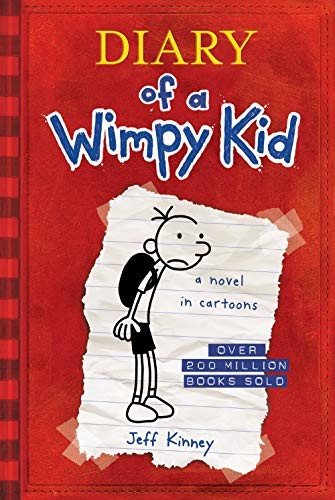
Diary of a Wimpy Kid
Jeff Kinney
For younger readers who loved Junior's cartoons and wry diary entries, Greg's doodled journal delivers the same mix of awkward school life and comic self-awareness, though with lighter stakes.
Reader-supported: when you buy through links on our site, we may earn an affiliate commission. Learn more
We earn a commission if you buy through these links. Learn more
Find Similar BooksA funny, raw, cartoon-studded novel about a Spokane teenager who leaves the reservation for a white high school, and the cost of chasing hope.
Arnold Spirit Jr., known as Junior, is fourteen, skinny, prone to seizures, and the target of constant bullying on the Spokane Indian Reservation. He draws cartoons to make sense of a world full of poverty, alcohol, and grief. When a teacher urges him to get out before the reservation crushes his hopes, Junior transfers to Reardan, a farm-town school twenty-two miles away where every other student is white. He becomes an outsider in both places: a traitor at home and a curiosity at school, especially to his best friend Rowdy.
The book is written as Junior's diary and interspersed with Ellen Forney's illustrations, presented as his own drawings. The voice is the main attraction. Junior is blunt, self-mocking, often hilarious, and he describes humiliation and heartbreak in the same breath. Short chapters and frequent jokes keep it moving quickly, even when the events turn very dark.
Reading it feels like riding a roller coaster between laughing out loud and being gut-punched. Alexie draws on his own reservation upbringing, and the story is clear-eyed about how systemic poverty shapes people while still insisting on individual choice, loyalty, and humor as survival tools. It won the National Book Award for Young People's Literature in 2007 and became a classroom staple. It also became one of the most frequently challenged books in American schools.
Junior's double life is the book's engine. On the reservation he is seen as abandoning his people. At Reardan he is a novelty who must earn respect. The novel shows how leaving a community to pursue opportunity can feel like betrayal, and it refuses to pretend that choice is painless or cleanly right.
Junior jokes about almost everything, including bullying, his body, and his family's money troubles. The comedy is not a way of avoiding pain. It is how he carries it. That balance makes heavy subjects approachable for teen readers without softening them, and it gives the book its distinctive, conversational energy.
The novel is direct about how poverty, alcoholism, and limited opportunity affect reservation life. It shows the toll on Junior's family and neighbors with affection rather than pity. Underneath runs a tough question: whether hope requires leaving, and what it means that so many people Junior loves never had that chance.
Junior's bond with Rowdy, a fierce and protective friend with a hard home life, is the emotional heart of the story. Junior's transfer turns them into rivals, especially on the basketball court. Their relationship gives the book its most tender and painful moments and grounds the larger themes in one friendship.
Forney's drawings are more than decoration. They carry jokes, capture Junior's feelings when words fail, and offer quick sketches of the people around him. The mix of diary text and cartoons makes the book especially inviting to reluctant readers and gives it a scrapbook-like intimacy.
Although it is often shelved as a children's book, it is really young adult fiction. Its frank talk about masturbation, its slurs, and its blunt treatment of alcoholism have led to many school challenges. Some Native readers and critics argue that it leans on bleak reservation stereotypes and frames leaving as the path to success. In 2018 Alexie faced sexual harassment allegations, and some educators and readers have since reconsidered teaching or recommending his work. Its picture of high school social life is also rooted in the mid-2000s.
Reviews from readers on YouTube. Their opinions are their own.
Book details and cover from Google Books.
Ready to read The Absolutely True Diary of a Part-Time Indian?
Get your copy on Amazon, or listen to it on Audible. We earn a commission if you buy through these links.
Jeff Kinney
For younger readers who loved Junior's cartoons and wry diary entries, Greg's doodled journal delivers the same mix of awkward school life and comic self-awareness, though with lighter stakes.
Jesse Andrews
Greg's self-deprecating, profane, hilarious narration about friendship and illness echoes Junior's way of joking through pain while still letting the sadness land.
Stephen Chbosky
Charlie's letters share Junior's intimate, confessional tone, following an outsider navigating high school, friendship, grief and family secrets with tenderness and humor.
Angie Thomas
Starr moves between her Black neighborhood and a mostly white prep school, wrestling with identity and loyalty much as Junior does between Wellpinit and Reardan.