
We earn a commission if you buy through these links. Learn more
Thank You for Smoking
A sharp, fast satire of a tobacco lobbyist who can argue anything, and whose charm makes the cynicism hard to resist, which is exactly the point.
What It's About
Thank You for Smoking (1994) is a satirical novel narrated by Nick Naylor, a spokesman for the tobacco industry whose job is to make the case for cigarettes on talk shows, in hearings, and in the press. Nick is very good at it, and the book is built around how good he is. Buckley lets you watch him work: the rhetorical tricks, the reframing of every attack, and the easy confidence of a man who treats arguing as a craft separate from believing.
The approach is comic and brisk. Chapters are short, the dialogue moves quickly, and the satire aims at lobbying, media spin, and the public's appetite for moral certainty, not just at tobacco. Nick moves among a loose circle of other industry spokesmen, and much of the humor comes from their rivalry and camaraderie as well as from Nick's one-liners. It is a book about rhetoric, and it reads more like a sharp comedy of manners than a thriller.
The experience is uncomfortable in a good way. Nick is charming and often funny, which makes his cynicism more fun and more unsettling. You laugh, then notice you have been laughed into siding with a man you would not trust with your car keys. The novel does not lecture. It trusts you to draw your own conclusions.
Read this if you…
- enjoy sharp, dialogue-driven satire with short chapters and quick jokes
- are curious how persuasion, spin, and public relations actually work
- like comedy that skewers institutions without tidy moral lessons
Skip it if you…
- want a plot-driven novel with high stakes and a clear narrative arc
- find a narrator who is cynical and enjoys his own cleverness hard to spend time with
Key Ideas
- 1
Arguing is a craft, separate from belief
Nick treats persuasion as a skill you can practice and deploy regardless of what you personally think. The book keeps returning to this distinction, and it is the source of much of the comedy and the discomfort. Watching him build a defense out of parts that have nothing to do with the truth is the main pleasure of reading it.
- 2
Spin as a kind of charm
Nick's most effective tool is likability. He disarms opponents by agreeing with them, reframing their points, and making them feel reasonable. Buckley shows how easily warmth and wit can carry an indefensible position, and he invites readers to notice how often they respond to the same tactics in ordinary life.
- 3
Satire of lobbying and the media machine
The novel takes aim at a system in which talk shows, hearings, and press coverage reward quick comebacks over substance. Buckley's targets are the professional machinery that turns a contested issue into a series of soundbites. The satire feels specific to its moment but the underlying dynamics of managed public argument remain recognizable.
- 4
Moral certainty as a product
Buckley also satirizes the market for outrage: the activists, reporters, and audiences who want clear villains and loud denunciations. The book suggests that both sides of a public fight can become performances, and that the appetite for righteousness is itself something the spin trade can sell back to people.
Limitations
The satire is tied closely to the early-1990s debate over tobacco, and some references and media details feel dated to modern readers. The episodic structure can feel loose, and some readers find the cleverness repetitive over a full book. Because Nick is so charming, the target of the satire can blur, which some readers see as a strength and others as a lack of clear judgment. The book is also lighter on emotional depth than its wit might suggest.
Questions Readers Ask
- Is Thank You for Smoking still relevant today?
- Yes, in its central concerns. The specific tobacco fights of the 1990s have changed, but the book's subjects, including managed messaging, professional persuasion, and the performance of public outrage, remain familiar. Readers today may notice period details, yet the core satire of how arguments get won in public still lands.
- How does the novel compare to the 2005 film?
- The film adaptation keeps the central premise and much of the comic tone, but the novel is looser and more digressive. Readers who know the movie will find the book has more room for Nick's running commentary and for the wider circle of spokesmen around him. Both work well, and the novel rewards a slower pace.
- Published
- 1995
- ISBN
- 9780233989440
- Difficulty
- beginner
- Category
- Fiction
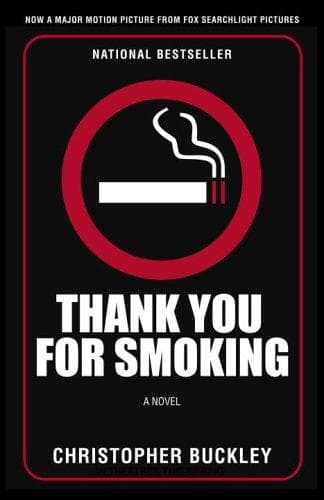
Book details and cover from Google Books.
Ready to read Thank You for Smoking?
Get your copy on Amazon, or listen to it on Audible. We earn a commission if you buy through these links.