
We earn a commission if you buy through these links. Learn more
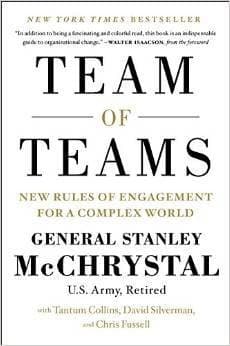
Team of Teams
by Stanley A. McChrystal, Tantum Collins
A practitioner's account of how a rigid military command learned to operate as a connected network, worth reading for anyone managing teams that have outgrown top-down control.
What It's About
Team of Teams is Stanley McChrystal's account of leading a special operations task force in Iraq against Al-Qaeda in Iraq, and of what he concluded about why a large, well-resourced military was losing to a loosely organized, decentralized enemy. Despite its Biographies category, this is less a life story than a leadership argument built around one long case study, shaped with co-author Tantum Collins and others.
The approach is anecdote-first. McChrystal walks through the moments that forced change: a daily cross-agency briefing that changed how information moved, the decision to open up data that had been guarded, and the slow work of getting units that distrusted each other to share one picture of the battlefield. The central claim is that speed and adaptability come less from better individual decisions than from shared awareness and trust, and that leaders have to loosen their grip on execution while staying close to what is actually happening.
Reading it feels like sitting in on a practitioner's post-mortem. The prose is direct, sometimes self-critical, and rarely academic, so you get the logic of the change more than the metrics behind it. Its strongest passages are the ones where the author admits what he got wrong. It offers little theory and no rigorous comparison of methods, so treat its conclusions as well-argued experience rather than proven science.
Read this if you…
- are leading a team or organization that has grown too large to coordinate from the top down
- want a candid, practitioner-level look at organizational change under pressure
- are interested in how to make large institutions faster and more adaptive
Skip it if you…
- want a conventional biography of the author or a detailed history of the Iraq War
- expect a step-by-step playbook or measurable evidence behind every claim
Key Ideas
- 1
Complex problems outpace rigid hierarchies
McChrystal argues that an enemy operating as a network can adapt faster than a pyramid-shaped command chain can pass information up and orders back down. The book shows how the mismatch of structures, not a lack of courage or firepower, produced repeated failures. Its core lesson is that organizations need to be built to match the problems they face.
- 2
Shared awareness beats hoarded information
Much of the book describes the effort to get intelligence, operations, and partner agencies looking at the same live picture. McChrystal presents information sharing as a discipline that has to be built deliberately, through routines and cultural change. The reader learns why secrecy that feels safe at the local level can paralyze the whole system.
- 3
Empowered teams executing within clear purpose
The book argues that leaders should set a clear intent and then let small teams make decisions on the ground. Autonomy is not presented as chaos; it works only when everyone understands the larger goal. The examples show how trust grows when people see one another doing the hard work.
- 4
Leaders shape conditions rather than issue every order
McChrystal describes his own shift from commanding each move to designing the rhythms, communication, and structure that let others act well. The change is uncomfortable and slow, and he is candid about how hard it was to give up control. Readers in management roles will find this the most transferable idea.
Limitations
Much of the evidence is anecdotal and comes from the author's own vantage point, so it is hard to separate what caused the improvements from everything else happening at the time. The military focus means some lessons need translation for businesses, nonprofits, or public agencies, and the book does not work through those differences in detail. Some readers find the narrative self-flattering in places, and the practical guidance is more principled than operational.
Questions Readers Ask
- Is Team of Teams really a biography?
- Not in the usual sense. Although it is listed under Biographies, it is mainly a leadership and organizational book built around McChrystal's experience commanding forces in Iraq. Personal history appears where it supports the argument, but the focus is on how the organization changed and why that change mattered.
- Is the book still relevant for managers outside the military?
- Yes, for the core ideas about information sharing, decentralized decision-making, and the limits of rigid hierarchy. Readers should expect to adapt the specifics to their own setting. It works best as a framework for thinking about coordination problems rather than a manual for running a company.
- Published
- 2015
- ISBN
- 9781611763720
- Difficulty
- beginner
- Category
- Biographies
Book details and cover from Google Books.
Ready to read Team of Teams?
Get your copy on Amazon, or listen to it on Audible. We earn a commission if you buy through these links.