
We earn a commission if you buy through these links. Learn more
Sway
by Ori Brafman
A quick, anecdote-driven tour of the hidden forces, like defaults, loss aversion and peer pressure, that quietly steer everyday decisions, useful if you want an accessible entry point to behavioral economics.
What It's About
Sway, co-written by Ori Brafman with his brother Rom Brafman and published in 2008, argues that people like to believe they choose rationally, while a set of predictable, mostly unconscious influences keeps pushing them in particular directions. The book takes research from psychology and behavioral economics and applies it to situations most readers recognize: buying things, negotiating, sticking with or abandoning habits, and how groups behave.
The style is anecdote-led. Sections tend to open with a vivid scene or story, connect it to a research finding, and then suggest what to do about the pattern. The writing is breezy and light on jargon, with a somewhat showman-like tone. Readers who already know Kahneman or Dan Ariely will recognize much of the territory. The Brafmans' contribution is mostly packaging and application rather than new experiments.
The experience is less like a textbook and more like a run of "that's me" moments. It works best as a first pass at why people repeatedly act against their own stated goals, and it encourages you to notice the defaults, framing, and social cues surrounding your own choices.
Read this if you…
- want a readable overview of behavioral economics applied to everyday decisions
- are puzzled by why good intentions keep failing in money, work, or relationships
- are new to this field and want an accessible starting point before tackling denser books
Skip it if you…
- want rigorous, citation-heavy science or a detailed look at the experiments themselves
- already know Thinking, Fast and Slow or Predictably Irrational well, since much of this will feel familiar
Key Ideas
- 1
The pull of the default and the status quo
People tend to stay with whatever option is already in place, whether that's a contract setting, a habit, or a job. The book shows how changing course feels costlier than it objectively is, and why small changes to the starting point can alter what people choose without anyone noticing.
- 2
Loss aversion and the value of what we already own
Losses tend to weigh more heavily than equivalent gains, so people overvalue things they possess and resist giving them up. The authors use this to explain stalled negotiations, reluctance to sell, and decisions made to avoid regret rather than to pursue upside.
- 3
Reciprocity and self-persuasion
Investing time, effort, or favors in something can make us like it more, partly because we infer our attitudes from our actions. The book explores how small commitments and exchanges quietly shape loyalty and belief over time.
- 4
Social proof and group influence
People look to peers and crowds to decide what is normal, appropriate, or worth wanting, often without realizing it. The discussion of group dynamics highlights how conformity and identity can override individual judgment in ways that are hard to see from the inside.
- 5
Emotion and framing over raw facts
How an option is presented, and what feelings it triggers, often matters more than the underlying information. The book argues that understanding this gap is the practical first step toward making choices you would endorse on reflection.
Limitations
The anecdotes are vivid but selective, and the book often presents findings more confidently than the underlying evidence warrants. Several studies from the period have been questioned or failed to replicate in later research, and the field has revised some of its best-known claims since 2008. The advice is generally offered without rigorous testing. Coverage is broad but shallow, so readers looking for a systematic framework they can apply step by step may come away wanting more.
Questions Readers Ask
- Is Sway worth reading if I have already read Thinking, Fast and Slow?
- Probably only as a lighter, applied companion. Kahneman goes much deeper into theory and evidence, while Sway is quicker, more story-driven, and focused on everyday persuasion and decision-making. Expect a fair amount of overlap in the core ideas, so it may feel more like a refresher than a new education.
- Is the book still relevant today?
- The core ideas about defaults, loss aversion, and social influence remain widely discussed and reasonably well supported. However, individual experiments cited in the book have been questioned since publication, so treat specific claims as starting points to verify rather than settled facts.
- Published
- 2008
- ISBN
- 9780753516829
- Difficulty
- beginner
- Category
- Self-Improvement
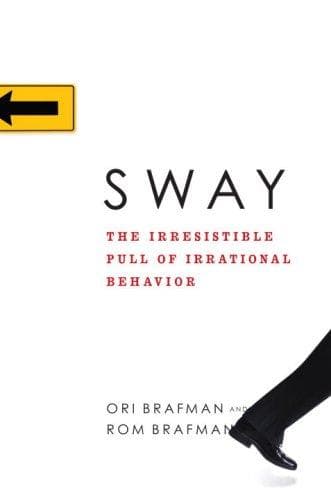
Book details and cover from Google Books.
Ready to read Sway?
Get your copy on Amazon, or listen to it on Audible. We earn a commission if you buy through these links.