
We earn a commission if you buy through these links. Learn more
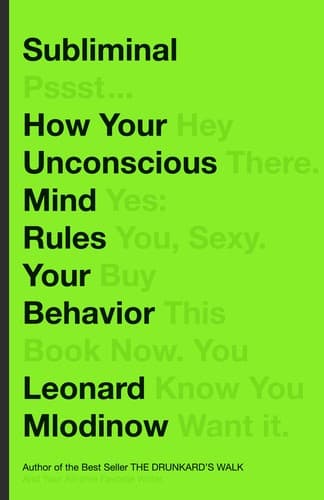
Subliminal
Mlodinow's accessible tour of how much of our behavior runs on unconscious processing, with a useful skeptical eye on the subliminal-advertising myths.
What It's About
Subliminal is a popular science book about the part of the mind that works below awareness. Mlodinow, a physicist who writes for general readers, pulls together decades of experimental psychology on perception, memory, emotion, and social judgment to argue that the conscious self is a much smaller player than we tend to assume. The book starts from the old question of whether messages too quick to notice can change behavior, then widens into priming, where exposure to one stimulus nudges later thoughts and actions.
The approach is narrative and anecdotal. He moves between laboratory studies, stories about researchers, and everyday examples, keeping technical detail light. The tone is brisk and conversational, with a physicist's habit of checking dramatic claims against the evidence. Reading it feels like being walked through a series of surprising experiments, each one making you a little less confident about your own motives.
The payoff is less a set of rules for living than a changed sense of where decisions come from. Readers should come away skeptical of claims about mind control, yet more aware of how context, cues, and automatic reactions shape ordinary choices.
Read this if you…
- are curious how perception and memory work beneath conscious awareness
- enjoy science writing that uses stories and experiments rather than heavy jargon
- want a skeptical, evidence-minded take on popular claims about hidden persuasion
Skip it if you…
- want concrete, step-by-step tools for changing habits or making better decisions
- expect a rigorous, up-to-date account of which psychology findings have held up
Key Ideas
- 1
Perception runs ahead of awareness
A great deal of what the brain takes in never reaches conscious attention. The mind sorts, filters, and interprets sensory input before you notice anything, which means your sense of having seen or decided something is often a late report on processing that already happened.
- 2
Priming shapes thought and behavior
Brief exposure to words, images, or concepts can subtly change later judgments and actions. The book explores how far these effects reach in daily life and where the research is strongest, showing that context can quietly steer what seems like a free choice.
- 3
Automatic bias in everyday judgment
Stereotypes and snap evaluations operate quickly and without permission. Mlodinow uses this to show why good intentions do not fully control reactions, and why people who sincerely reject prejudice can still act on it in split-second moments.
- 4
Separating myth from measurable effect
The book revisits the legend of subliminal advertising and contrasts it with more modest, context-dependent findings. The lesson is that the unconscious is real and influential, but it is not a hidden switch that others can flip at will.
Limitations
Subliminal was written in 2012, before the major replication failures that hit social priming research. Several striking effects it describes, such as those involving money or behavior cues, have since proven harder to reproduce in larger studies, so the effect sizes may be overstated. The book is also broad rather than deep, and its practical advice is thin. Readers who want the strongest current evidence should treat its confident framing with some caution and check newer sources.
Questions Readers Ask
- Is Subliminal still worth reading given the replication debate?
- Yes, as a readable overview of how the unconscious shapes perception and judgment. Read it for the big picture and the critical attitude toward hidden-persuasion myths, but verify specific priming studies against later replication work before relying on them.
- How does Subliminal compare to Thinking, Fast and Slow?
- Kahneman's book is deeper, more systematic, and more focused on judgment and heuristics. Mlodinow's is lighter and more anecdotal, concentrating on unconscious perception and priming. If you want one book on decision-making, choose Kahneman; if you want an accessible entry point into the unconscious, Subliminal works well.
- Published
- 2012
- ISBN
- 9780307472250
- Difficulty
- beginner
- Category
- Subconsciousness
Book details and cover from Google Books.
Ready to read Subliminal?
Get your copy on Amazon, or listen to it on Audible. We earn a commission if you buy through these links.