
We earn a commission if you buy through these links. Learn more
Stumbling on happiness
Guide by the Books of the Day editors · Updated · How we write our guides
Gilbert's accessible tour of why we mispredict our own future happiness, and why the mistakes are less damaging than we fear.
What Creators Say About Stumbling on happiness
2 creators reviewed Stumbling on happiness on YouTube between 2015 and 2021, with 80.7K views between them. Their opinions are their own; we picked these reviews, we didn't write them.
What It's About
Stumbling on Happiness is a work of popular psychology, not fiction, despite the category listed for it here. Daniel Gilbert, a Harvard psychologist, uses the 2006 book to examine affective forecasting, our ability to predict how future events will make us feel. His central claim is that we are poor at this, and that the errors follow patterns researchers can study. The book is built around experiments and everyday examples, told with a good deal of humor.
Gilbert writes in a conversational voice, moving from laboratory findings to thought experiments and anecdotes about ordinary choices like careers, homes, and relationships. He spends less time giving advice than explaining why the mental shortcuts behind our predictions go wrong. Reading it feels like sitting in on a lively lecture from someone who enjoys the subject and wants you to see why your intuitions about happiness can't be fully trusted.
The experience is light on jargon but dense with ideas, and it rewards readers who like to think about why people want what they want. It is short enough to finish in a few sittings, and its conclusions are more hopeful than the premise suggests: the mind is better at recovering from setbacks than it expects.
Read this if you…
- want a research-backed look at why your predictions about happiness keep going wrong
- enjoy witty, anecdote-driven popular science more than self-help checklists
- are facing a big life decision and want to understand the common traps in forecasting
Skip it if you…
- want a practical, step-by-step plan for becoming happier
- need current research, since the book reflects work from the mid-2000s
Key Ideas
- 1
We are poor forecasters of our own feelings
Gilbert argues that people routinely misjudge how they will feel after future events, such as a promotion, a breakup, or a move. The problem is not that we lack information but that the mind builds an imagined future that differs from the one we will actually live through. Much of the book is an attempt to map where those predictions drift and why.
- 2
Impact bias: overestimating how intensely we will feel
We tend to exaggerate both the strength and the duration of emotions tied to future events. Gilbert explains that the mind has built-in ways of making sense of setbacks, which he calls a psychological immune system, and that we consistently underestimate how well these work. The result is that bad outcomes often hurt less, and for less time, than we expect.
- 3
Synthetic happiness: the happiness we make ourselves
Gilbert distinguishes between happiness that comes from getting what we want and happiness we construct by changing how we interpret our circumstances. He argues that the second kind is not a lesser imitation but is often just as real to the person experiencing it. This idea reframes the question of whether we can make ourselves happier.
- 4
Miswanting: why we chase the wrong things
Because we focus heavily on one feature of a future situation, we overestimate how much that feature will shape our overall well-being. Gilbert uses this to explain why people sometimes pursue goals that bring less satisfaction than they hoped. The book suggests that many everyday wants are based on flawed mental snapshots.
Limitations
Some critics argue that Gilbert leans on a relatively small set of experiments and presents them with more confidence than they can bear, a common complaint about popular psychology. Psychology has since faced replication concerns, and not every effect cited in the book has held up equally well in later work. The book also reflects its era and its mostly university-based examples, and it offers less concrete guidance on what to do than some readers hope for.
Questions Readers Ask
- Is Stumbling on Happiness a novel?
- No. It is nonfiction, a popular science book about how people predict and experience emotion. The fiction category on this listing appears to be an error, so you should expect research, examples, and argument rather than a story with characters and a plot.
- Is Stumbling on Happiness still relevant?
- Yes, the core ideas, such as impact bias and the gap between predicted and actual feelings, are still widely discussed and cited. Some examples feel dated, and later research has refined or questioned certain findings. It remains a good starting point, especially if you then read more recent work.
- How does it compare to Thinking, Fast and Slow?
- Kahneman's book covers a broad range of judgment and decision-making biases. Gilbert's book is narrower, focused on how we predict our future emotions, and has a warmer, more playful tone. If you want the wider picture, Kahneman is the better choice. If you want a closer look at happiness, Gilbert fits well.
- Published
- 2006
- ISBN
- 9780676978582
- Difficulty
- beginner
- Category
- Fiction
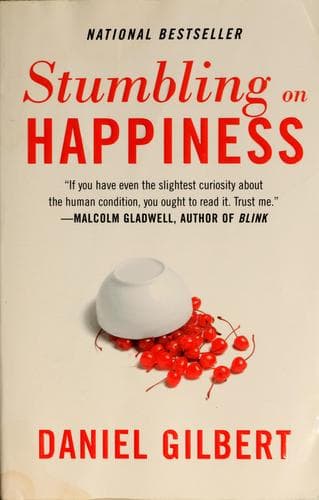
Book details and cover from Google Books.
Ready to read Stumbling on happiness?
Get your copy on Amazon, or listen to it on Audible. We earn a commission if you buy through these links.