
We earn a commission if you buy through these links. Learn more
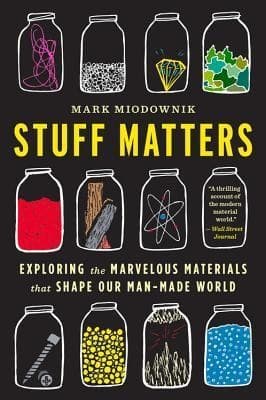
Stuff Matters
Guide by the Books of the Day editors · Updated · How we write our guides
A materials scientist's engaging case that the stuff around us, from chocolate to steel, hides fascinating science and has shaped human history, told with warmth and wonder.
What Creators Say About Stuff Matters
2 creators reviewed Stuff Matters on YouTube between 2013 and 2014, with 15.2K views between them. Their opinions are their own; we picked these reviews, we didn't write them.
What It's About
Stuff Matters is a tour of the materials that build our world, written by a materials scientist who clearly never lost the childhood habit of asking how things work. Miodownik takes familiar substances such as chocolate, concrete, steel, glass, and paper and treats each as a story: how it was found or refined, why it behaves the way it does, and what that behavior has meant for the people who relied on it. The book moves between the laboratory and the kitchen, the building site and the museum, so a sentence about crystal structure can sit beside a memory of a cup of tea.
The tone is personal and conversational rather than textbook. He writes about his own curiosity and wonder, and he is comfortable admitting where a tidy explanation gives way to open questions. Chapters are self-contained enough to dip into, though the book reads best straight through, since later ideas build on physics introduced earlier.
The experience is closer to a relaxed walk with an enthusiastic guide than to a lecture. Expect little math, a steady stream of concrete examples, and a growing sense that the objects you ignore every day were quietly engineered by centuries of trial and error.
Read this if you…
- are curious about how ordinary objects are made and why they behave the way they do
- enjoy popular science that mixes personal storytelling with real chemistry and physics
- are a student or practitioner wanting an accessible entry point before tackling more technical texts
Skip it if you…
- want a rigorous technical treatment with equations, data tables, and detailed engineering analysis
- are looking for narrative nonfiction with characters and a plot to carry you forward
Key Ideas
- 1
Materials have shaped the course of history
Entire eras of human progress have been tied to what people could make things from. Access to a particular material, and the skill to work it, often determined which tools, buildings, and technologies were possible. Miodownik uses this thread to show that materials are not background scenery but active forces in economics, war, and daily life.
- 2
Familiar foods hide surprising physics
Chocolate is a useful example of how small-scale arrangement controls everyday qualities. Whether it snaps cleanly and looks glossy depends on how its fat crystals are organized, which is why careful tempering matters. The book makes this kind of hidden detail feel like a revelation about something you already eat without a second thought.
- 3
Tiny structures determine big behavior
A recurring lesson is that what a material does at human scale is set by what happens at the scale of atoms and grains. Strength, brittleness, transparency, and flexibility all trace back to internal structure. Once you see this pattern, you start to understand why one substance can be useful in a bridge and another in a window.
- 4
Design is a dialogue between people and matter
Choosing a material is always a compromise between cost, performance, availability, and what people will accept. Miodownik shows how engineers learn through failure and refinement, and how the materials we pick reflect social priorities as much as technical ones. This framing makes the book relevant to questions about manufacturing and waste.
Limitations
The book covers a wide range of materials but goes deep on few of them, so readers wanting a full account of any one material will need more specialized sources. Some explanations are simplified for a general audience, which experts may find too light. The discussion of industrial production, economics, and environmental impact is less developed than the science, and some readers may wish the author pushed harder on the trade-offs of modern manufacturing.
Questions Readers Ask
- Is Stuff Matters suitable for readers with no science background?
- Yes. The book is written for a general adult audience and avoids heavy mathematics. Basic curiosity about everyday objects is more important than prior training. Some passages on atomic structure may need a slower pace, but the examples are concrete and the author explains terms as he goes.
- How does it compare with Bill Bryson's At Home?
- Both books use ordinary objects and places to tell wider stories. Stuff Matters is more focused on the science of materials and how they behave, while At Home ranges across social and domestic history. Readers who enjoy one usually find the other appealing, though Miodownik's approach is more technical.
- Published
- 2013
- ISBN
- 9781306788762
- Difficulty
- beginner
- Category
- Science
Book details and cover from Google Books.
Ready to read Stuff Matters?
Get your copy on Amazon, or listen to it on Audible. We earn a commission if you buy through these links.