
We earn a commission if you buy through these links. Learn more
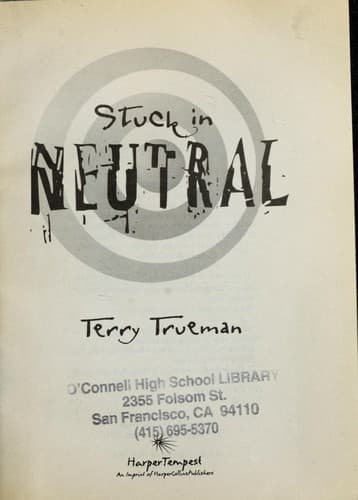
Stuck in neutral
Guide by the Books of the Day editors · Updated · How we write our guides
A short, emotionally direct novel told from inside the mind of a boy who cannot move or speak, asking hard questions about family, disability, and who decides what a life is worth.
What Creators Say About Stuck in neutral
2 creators reviewed Stuck in neutral on YouTube between 2012 and 2024, with 1.2K views between them. Their opinions are their own; we picked these reviews, we didn't write them.
What It's About
Stuck in Neutral is a short young adult novel narrated by a boy who can hear, think, and feel, but cannot control his body or speak. Trueman gives the reader that same position: the world arrives as observation, and most of the narrator's frustration, humor, and affection stays internal. The prose is plain and direct, and the story moves through his memories and his running commentary on the adults who talk about him as if he were not in the room.
The central tension comes from his father's private thoughts about whether his son's life is still worth living. Trueman builds the book around that question rather than around plot mechanics, so reading it feels less like following a thriller and more like sitting through a difficult conversation. Expect a lot of interior reflection, tender moments within the family, and a steady, uncomfortable pressure that grows as the reader starts to see what the narrator sees.
Because it is brief, it can be read in one sitting, and it is widely taught in middle and high school classrooms, so many readers arrive expecting a discussion. It rewards attention to voice: the narrator's wit and love come through clearly despite his limits.
Read this if you…
- want a short, emotionally direct novel you can finish in a single sitting
- are interested in disability and end-of-life ethics told from the inside
- want to understand how disabled people experience being talked about rather than talked to
Skip it if you…
- need fast plotting, twists, or action to stay engaged
- are not in the mood for heavy material about death, caregiving strain, and family conflict
Key Ideas
- 1
Being present but unable to be heard
The novel's core device is a mind that works fully inside a body that does not respond. Trueman uses this to show how easily people assume that a disabled person has no inner life, and how often that assumption shapes what gets said in front of them. The reader is positioned to notice every careless remark the narrator cannot answer.
- 2
Who gets to decide what a life is worth
The father's dilemma about ending his son's life is the book's moral engine. Trueman does not reduce it to a debate with a clean answer. Instead he asks the reader to weigh mercy, exhaustion, love, and the limits of what a caregiver can bear, and to notice whose judgment is being treated as final.
- 3
The gap between perception and assumption
Much of the book's force comes from the distance between what the narrator understands and what the adults around him believe. Readers become aware of that gap early and carry it through the story, which makes the family's conversations feel increasingly painful to watch.
- 4
Voice as the main craft
With little movement or dialogue in the usual sense, the book depends on its narrator's voice. The sentences are spare and unsentimental, and the humor and resilience in them keep the book from becoming only a sad story. Readers who enjoy close first-person narration will find much to admire here.
Limitations
The book is deliberately narrow in perspective. We see the father mostly through his son's eyes, so his reasoning is never explored in full, and some readers feel the story leans toward one conclusion. Its framing of a disabled character's suffering has also drawn criticism from disability advocates, who question how a non-disabled author represents disabled life and whether the book's central premise reinforces the idea that such lives are a burden. Its brevity means some characters and relationships stay underdeveloped. Readers looking for a nuanced, fully balanced treatment of these questions may want to pair it with other sources.
Questions Readers Ask
- Is Stuck in Neutral suitable for adult readers?
- Yes. Although it is classed as young adult and is often taught in schools, its themes of disability, family strain, and end-of-life ethics are serious and adult in weight. Adults who can handle emotionally heavy material will find it accessible and affecting, and it is a good choice for a quick read that still asks substantial questions.
- What should I read if I like this book?
- If the voice and perspective are what drew you in, Mark Haddon's The Curious Incident of the Dog in the Night-Time offers a similarly close, distinctive narrator who sees the world differently from those around him. Readers who want more on disability and family decision-making might look for nonfiction memoirs written by disabled people themselves.
- Published
- 2000
- ISBN
- 9780340805992
- Difficulty
- beginner
- Category
- Fiction
Book details and cover from Google Books.
Ready to read Stuck in neutral?
Get your copy on Amazon, or listen to it on Audible. We earn a commission if you buy through these links.