
We earn a commission if you buy through these links. Learn more
Stories of Your Life and Others
by Ted Chiang
Guide by the Books of the Day editors · Updated · How we write our guides
Ted Chiang's first collection pairs elegant science fiction ideas with deeply human stories about language, time, and loss, making it a rewarding entry point into the genre.
What Creators Say About Stories of Your Life and Others
2 creators reviewed Stories of Your Life and Others on YouTube between 2019 and 2020, with 20.8K views between them. Their opinions are their own; we picked these reviews, we didn't write them.
What It's About
Stories of Your Life and Others is a collection of short fiction by Ted Chiang, a writer who publishes slowly and carefully. Most of the pieces are science fiction, but the science usually works as a lever rather than a set of gadgets. Chiang starts from a what-if about how a technology, a physical law, or a change in how minds work would alter daily life, then follows that premise until it presses on relationships, faith, work, and identity. Several stories use unusual forms, including documentary-style and essay-like structures.
Reading the collection feels closer to working through a puzzle with a patient guide than to being swept along by plot. The prose is clear and unshowy, and Chiang rarely hurries past a concept he thinks needs room. Some stories are built around a single question and resolve it with a satisfying click; others are quieter, asking what a discovery would cost a person emotionally. Expect to slow down, reread a passage, and sometimes sit with the idea afterward.
Taken together, the book is less a set of disconnected experiments than a sustained inquiry into how people make meaning when their assumptions are challenged. The stories range widely in tone and setting, from ancient history to near-future laboratories, which keeps the collection from feeling repetitive even though its concerns recur.
Read this if you…
- enjoy idea-driven science fiction where the concept matters as much as the characters
- want an accessible entry point to literary sci-fi that rewards rereading
- are curious about language, mathematics, or the philosophy of choice
Skip it if you…
- want fast-paced action, space battles, or a continuing series
- prefer sprawling novel-length plots with a wide cast and slow-building momentum
Key Ideas
- 1
The concept drives the story
Chiang usually begins with a single hypothetical and tests its consequences with real rigor. The thrill comes from watching an idea unfold logically and then turn on the characters who live inside it. If you read sci-fi mainly for character drama or spectacle, you may find the premises do more work than the people, but the reasoning is rarely careless.
- 2
Language and perception shape what we know
Several pieces treat language, mathematics, and the way we describe experience as active forces rather than neutral tools. Chiang asks how a different grammar or a different notation might change what a mind can notice or feel. These stories reward readers who enjoy linguistics or who have ever felt that a word was missing from their vocabulary.
- 3
Free will against foreknowledge
A recurring question is what choice means when the future is known or fixed. Chiang explores this without settling for easy answers, and he is interested in how people behave once they accept limits on their agency. The discussion is thoughtful rather than preachy, and it invites you to test your own intuitions about responsibility.
- 4
Faith meeting empirical evidence
Some stories examine what happens when religious belief collides with measurable reality. Chiang is respectful toward believers and skeptics alike, and he avoids treating either worldview as a joke. The result is a set of pieces that feel like honest arguments rather than polemics.
- 5
Technology and the cost of certainty
Several stories ask what we lose when we can see, record, or predict more of our lives. The tone is measured, and the ethical stakes are personal more than apocalyptic. These pieces tend to linger because they show how a clever invention can quietly reshape desire, memory, and trust.
Limitations
Some readers find the collection cerebral to a fault. Characters can feel like vehicles for ideas, and emotional payoffs arrive quietly or not at all. A few pieces lean on exposition, and the restrained tone can read as cool or distant. Some technological assumptions may feel dated to readers who came to the book years after it appeared, though the human questions still hold up well. If you want the sweep and immersion of a novel, the collection will feel narrower than you expect.
Questions Readers Ask
- Do I need to like science fiction to enjoy this collection?
- Not necessarily. Many readers come to it from literary fiction because Chiang's sentences are clean and his characters are sincere. The science is there to raise questions about people, so if you are willing to follow an idea patiently, the genre matters less than you might think. Readers who dislike technical detail may still find the human stakes engaging.
- How does it compare to the film Arrival?
- The film Arrival (2016) is loosely based on the collection's title story, which is the best-known piece here. The movie reshapes the material into a thriller with a different emotional focus. Reading the original gives you a more philosophical and compact experience, and it is worth doing whichever order you choose.
- Is the collection still worth reading today?
- Yes. Its central concerns about language, choice, belief, and technology remain current, and the writing has not aged in the way that flashier genre work sometimes does. A few specifics may feel familiar now, but the stories are built on questions rather than on fashions, which is why they continue to attract new readers.
- Published
- 2002
- ISBN
- 9780525433675
- Difficulty
- intermediate
- Category
- Science Fiction
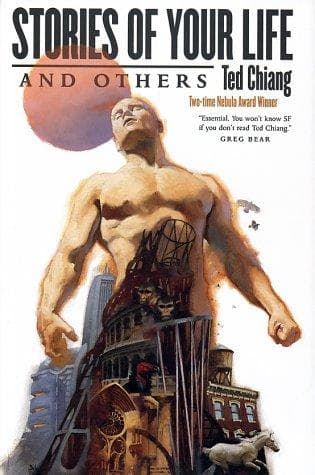
Book details and cover from Google Books.
Ready to read Stories of Your Life and Others?
Get your copy on Amazon, or listen to it on Audible. We earn a commission if you buy through these links.