
We earn a commission if you buy through these links. Learn more
Stitches
by David Small
A spare, unsettling graphic memoir that shows how a childhood of family silence and a frightening medical event can shape a whole life, told with striking black-and-white art.
What It's About
Stitches is a graphic memoir about David Small's childhood in Detroit in the 1950s. Its central event is a surgery he underwent as a teenager, when a growth on his neck was removed and his voice was left badly damaged. The family never talked about what happened, and the book is largely about that silence: the unspoken fear, the emotional coldness at home, and the way a young person learns to act as if nothing is wrong.
The approach is visual first. Small works in heavy, high-contrast black and white, with cramped panels, dense shadows, and dream sequences that blur into memory. Text is sparse, so much of the meaning sits in the images and in the gaps between them. It is a quick read, often finished in one or two sittings, but the images stay with you and invite rereading.
Reading it feels like sitting with someone who is working hard to describe something they were never allowed to name. The book does not offer a tidy story of recovery or a neat moral. It is more interested in how a child interprets confusing adult behavior and how those interpretations carry into adulthood.
Read this if you…
- Want a short, intense memoir that uses art as its main storytelling tool
- Are interested in how family silence and medical trauma shape adult identity
- Enjoy graphic novels that trust the reader to fill in emotional gaps
Skip it if you…
- Need a clear, explicit account of events with firm answers about what caused them
- Find dark, heavy family material hard to sit with, especially in a short but bleak book
Key Ideas
- 1
Silence as a family inheritance
The book's main concern is what goes unsaid. The household treats illness and fear as things to be managed quietly, and Small shows how that habit teaches a child that his own experience doesn't count and can't be discussed. The silence is presented as a force that shapes him, not just background.
- 2
Medicine as both cure and threat
Doctors and hospitals appear as sources of care and as sources of harm. Small's story raises the possibility that the treatment itself may have contributed to his illness, and he leaves that uncertainty unresolved. The result is a sharp look at how trust in authority can be complicated by what it does to you.
- 3
Art as a way to speak when voice fails
With his voice damaged, drawing becomes his main means of expression. The memoir treats the act of making images as both an escape and a necessity. Watching him turn to art in a home where words are scarce is one of the book's most quietly moving threads.
- 4
Images that carry emotional logic
Small uses stark composition, shifting perspective, and symbolic imagery to convey feelings a conventional narrative might state directly. Readers who want clear explanations may find this demanding, but the approach suits a story built on fragments, half-understood moments, and what a child can only sense.
Limitations
Some readers find the book bleak and withholding. Its refusal to explain everything can feel frustrating if you expect a full accounting of the family dynamics or the medical history. The sparse text also means that certain events may be hard to follow without slowing down and studying the panels. Because it is a single personal account, it reflects one child's perspective and should not be read as a complete picture of the period or the people involved.
Questions Readers Ask
- Is Stitches suitable for teenagers?
- Many older teens can handle it, and it is often taught in schools and libraries. It deals with serious illness, family coldness, and a sense of parental failure, and some images are stark. Readers sensitive to medical trauma or emotional neglect should be prepared for a heavy experience, even though the book is short.
- How does Stitches compare to Maus?
- Both are graphic memoirs about painful family histories told with a restrained visual style. Maus is structured around interviews with a father and a larger historical frame, while Stitches is more compact and focused on one childhood and one surgery. Stitches is more intimate and less explanatory, so readers who liked Maus's documentary weight may find it more elliptical.
- Published
- 2009
- ISBN
- 9780393338966
- Difficulty
- intermediate
- Category
- Biographies
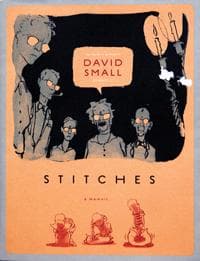
Book details and cover from Google Books.
Ready to read Stitches?
Get your copy on Amazon, or listen to it on Audible. We earn a commission if you buy through these links.