
We earn a commission if you buy through these links. Learn more
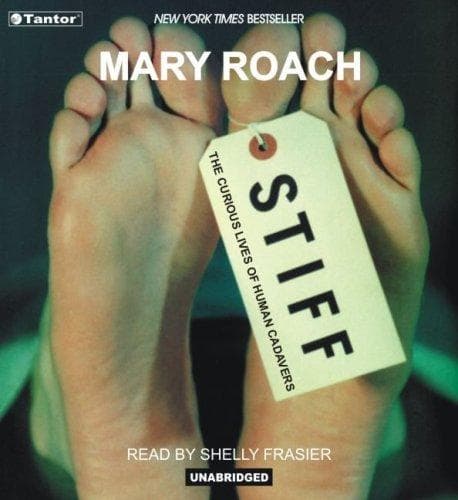
Stiff
Mary Roach follows donated human bodies into medical schools, crash labs and decay research, with a reporter's curiosity and humor that makes an uncomfortable subject surprisingly engaging.
What It's About
Stiff is Mary Roach's 2003 look at what becomes of human bodies after death, and the surprising ways they keep serving the living. Roach, a science writer, takes the subject seriously without treating it solemnly. She traces donated cadavers through the places that use them: anatomy labs where students learn the body, crash test facilities, forensic research sites where scientists study decomposition, and surgical training rooms where doctors practice new techniques.
The approach is reportorial. Roach visits the people who work with the dead, asks blunt questions, and reports the answers with curiosity that is often funny and occasionally squeamish. Her humor comes from the situations themselves and from her willingness to be the outsider who asks what everyone else has stopped wondering about. Each section stands fairly well on its own, so you can read it in one sitting or dip in and out.
Reading it feels closer to a conversation with a very good tour guide than to a textbook. It is light on jargon, heavy on concrete detail, and often gross in ways that are educational rather than gratuitous. Expect to finish with a changed view of what your own body might be for after you are gone, and a larger sense of how much of modern medicine and engineering rests on people who never expected to be studied.
Read this if you…
- are curious about how medicine, science and safety research work behind the scenes
- want popular science with a reporter's sense of humor and a lot of concrete detail
- can handle frank talk about bodies and want to understand them more clearly
Skip it if you…
- want a rigorous, technical account of anatomy, forensics or engineering
- find descriptions of dissection or decomposition too upsetting to read at any level of detail
Key Ideas
- 1
The body as the first teacher
Donated cadavers are still the main way many medical students learn human anatomy. Roach looks at what that training involves, from the first unsettling encounter in the lab to the practical lessons about variation between bodies that no diagram can teach. She shows how much of a doctor's hands-on knowledge is built on people who gave their bodies for that purpose.
- 2
Death as a tool for engineering safety
Crash testing and injury research have long relied on human remains, because no dummy fully matches how real tissue and bone respond to force. Roach explains why cadavers were valuable to these studies and what that reliance says about how safety standards are built. The book makes the case that some everyday protections exist partly because of research nobody thinks about while buckling a seatbelt.
- 3
Decay as something science can measure
Forensic researchers study how bodies break down in different conditions, and that knowledge helps investigators estimate time of death and understand what happens to remains outdoors or in buildings. Roach shows the scientific seriousness behind these projects, which can look grim from the outside. The chapters reveal how much practical value comes from patient observation of something most people try to avoid thinking about.
- 4
Consent, dignity and the donor's wishes
Roach keeps returning to the question of what donors agree to and what their families and institutions actually do with their bodies. She is attentive to the gap between a donor's intentions and the realities of research, teaching and disposal. This thread gives the book an ethical backbone beneath the jokes, and it asks readers to think about their own choices.
- 5
Humor as a way into discomfort
The distinctive quality of the book is its tone. Roach uses wit and self-deprecation to make readers comfortable enough to look closely at difficult material. The humor is not a way of avoiding the subject; it is a method for getting closer to it without flinching, and it is the main reason the book reads so quickly.
Limitations
Roach focuses mainly on American and some European settings, and the book is more than twenty years old, so specific practices, technologies and regulations have changed. Some readers feel the humor sometimes lightens serious ethical questions that deserve more weight. Because the book surveys several fields, it offers breadth rather than depth in any one of them, so anyone wanting a full treatment of a single topic will need further reading.
Questions Readers Ask
- Is Stiff still relevant today?
- Yes. The core subject, how donated bodies serve medicine and safety research, has not changed much, and the book's curiosity and framing still hold up well. Specific technologies, rules and numbers have moved on since the early 2000s, so treat the detailed claims as a snapshot and use the book for its perspective and storytelling.
- How does Stiff compare to Bill Bryson's A Short History of Nearly Everything?
- Both are funny popular science books, but Stiff is narrower and more hands-on. It stays with one subject, the human body after death, and goes deep into the people and rooms that work with it. Bryson sweeps across the whole history of science, while Roach takes readers into places most will never enter.
- Published
- 2003
- ISBN
- 9780670912179
- Difficulty
- beginner
- Category
- Lijken
Book details and cover from Google Books.
Ready to read Stiff?
Get your copy on Amazon, or listen to it on Audible. We earn a commission if you buy through these links.