
We earn a commission if you buy through these links. Learn more
Speaker for the Dead
Guide by the Books of the Day editors · Updated · How we write our guides
Card's Hugo-winning sequel to Ender's Game turns a stranger's funeral-speech ritual into a humane, morally knotty mystery about strangers and the aliens we misjudge.
What Creators Say About Speaker for the Dead
2 creators reviewed Speaker for the Dead on YouTube between 2022 and 2023, with 13.8K views between them. Their opinions are their own; we picked these reviews, we didn't write them.
What It's About
Speaker for the Dead is the 1986 sequel to Ender's Game, set roughly three thousand years after that book. Ender, now a grown man who has tried to leave his old reputation behind, works as a Speaker for the Dead, a figure whose job is to tell the whole truth about a person's life after death, flaws included, rather than deliver the polite eulogy a community expects. He is called to a remote colony where two humans have been killed by the native pequeninos, and the case pushes him to weigh what the dead owe the living and what the living owe the dead.
The novel moves between the investigation in the present and a set of earlier threads, with sections that feel like documents, letters, and testimony as much as conventional narration. The prose is plain and direct, and the tone is more reflective than action-driven. Much of the colony's culture is shaped by Catholic traditions and family ties, which gives the setting texture and makes its moral arguments feel grounded.
Reading it is a patient, talky experience. It works more like a mystery crossed with a family drama and an anthropology study than a space opera, with little combat and a lot of conversation. It rewards close attention and asks different questions from its predecessor, mostly about empathy, judgment, and what it means to really know another mind.
Read this if you…
- enjoy slow, character-driven science fiction where ideas matter more than action
- want to know what happens to Ender after Ender's Game
- are interested in how cultures handle grief, blame, and moral judgment
Skip it if you…
- want fast battles, a tight plot, or a space-opera pace
- are looking for a standalone novel, since it leans heavily on the first book
Key Ideas
- 1
Telling the whole truth about the dead
The Speaker's central practice is to describe a dead person's life honestly, including cruelty, weakness, and contradiction, rather than offering a flattering summary. The book uses this ritual to ask what honesty costs the speaker and the community, and whether truth can heal grief or only reopen it. Much of the emotional tension comes from watching characters react to accounts that refuse easy comfort.
- 2
Understanding the other as a path to peace
The pequeninos are the book's main test of empathy. Card keeps asking whether understanding an unfamiliar mind is possible, and whether it is enough to prevent violence. The novel treats misunderstanding as a moral failure with real consequences, not just a plot device, and it makes the reader work to see the aliens as more than a threat.
- 3
Guilt, atonement, and living with the past
Ender carries the weight of what he did in the earlier war, and the novel explores whether a person can be forgiven for an act that cannot be undone. Instead of a clean redemption arc, the book looks at how someone lives after causing great harm, and how others decide whether to trust them again.
- 4
Families, faith, and small human choices
Some of the strongest scenes are domestic, focused on the colonists' marriages, households, and religious life. These sections ground the big questions in ordinary relationships. The warmth and specificity of this material is one reason readers often remember the book more for its people than its ideas.
Limitations
Critics often find the pacing slow, especially in the middle, where investigation and reflection take up a lot of room. The shifting structure and document-like interludes can feel repetitive to some readers. The religious and cultural framing is heavy and may not suit everyone. Card's later public statements and political views have led some readers to avoid his work, and his portrayal of gender roles reads as dated to many modern readers. The book also does not offer deep scientific detail about its alien biology.
Questions Readers Ask
- Do I need to read Ender's Game first?
- Yes, strongly recommended. The novel assumes you know Ender's history, and much of its emotional weight comes from that earlier story. It can be read on its own with some context lost, but readers who skip the first book often find the central relationships harder to feel.
- Is Speaker for the Dead still worth reading today?
- For many readers, yes. Its questions about empathy, grief, and honest judgment hold up well. Its depiction of contact between humans and an alien people is worth reading critically, since the colonial framing has been debated. It remains one of the more morally serious entries in the genre.
- Published
- 1986
- ISBN
- 9780812550757
- Difficulty
- intermediate
- Category
- Science Fiction
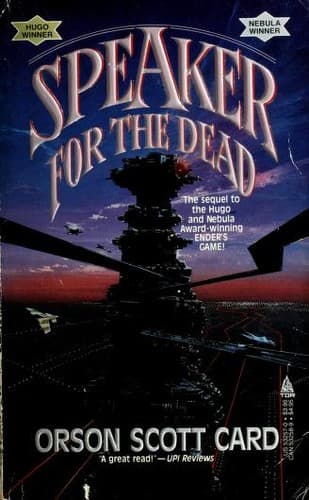
Book details and cover from Google Books.
Ready to read Speaker for the Dead?
Get your copy on Amazon, or listen to it on Audible. We earn a commission if you buy through these links.