
We earn a commission if you buy through these links. Learn more
Spacetime and geometry
Guide by the Books of the Day editors · Updated · How we write our guides
Carroll's clear, geometry-first textbook is one of the best routes into general relativity, but only if you already have solid calculus and linear algebra.
What It's About
Spacetime and Geometry is a graduate-level textbook, and it reads like one. Carroll starts from special relativity and builds toward Einstein's field equations, treating gravity as the curvature of spacetime. The book's distinguishing feature is its emphasis on geometric intuition: the mathematics of manifolds, tensors, and curvature is introduced in service of physical pictures rather than as an end in itself.
The writing is conversational for a technical text, with frequent asides, worked examples, and exercises that reward working through them. Carroll spends real time on the Schwarzschild solution and black holes, on cosmology and the expanding universe, and on linearized gravity and gravitational waves. You will not get a popular-science narrative here. You get the derivations.
Reading it is slow, deliberate work. Expect to spend many evenings on a single chapter, checking index notation and tensor manipulations by hand. The payoff is that by the end, the field equations stop looking like a magic formula and start looking like a statement about how energy and matter determine the shape of space and time.
Read this if you…
- are a physics or math student preparing for a serious course in general relativity
- already know special relativity and want to understand why gravity bends it into curved geometry
- want to learn the mathematics of tensors and curvature through physical examples rather than abstract theory alone
Skip it if you…
- are looking for an accessible overview of Einstein's theory or a popular-science story about black holes
- have not yet studied multivariable calculus and linear algebra and do not want to fill those gaps first
Key Ideas
- 1
Gravity as the geometry of spacetime
The central move is to stop thinking of gravity as a force acting across space and to treat it as a property of the spacetime itself. Objects follow the straightest possible paths through a curved geometry, and what looks like pulling is the consequence of that curvature. Carroll returns to this picture repeatedly, so it becomes the lens for everything else in the book.
- 2
Tensors as the language of physics
Much of the early effort goes into learning tensors, the objects that let physical laws take the same form in any coordinate system. This can feel like bookkeeping at first. The book justifies the machinery by showing how it keeps statements about spacetime honest, and by the later chapters the notation starts to carry real physical meaning.
- 3
Curvature and how it is measured
Carroll builds up the Riemann curvature tensor and explains how it captures the way nearby freely falling paths drift apart or together. Getting comfortable with curvature is the hardest conceptual step in general relativity, and the book gives it more room than most introductions do, with geometric examples that make the abstraction concrete.
- 4
Black holes, cosmology, and gravitational waves
The field equations are applied to real systems: the exterior of a spherical mass, black hole geometry, and the expanding universe. The later material on linearized gravity explains how ripples in spacetime behave like waves. These applications are where the theory's predictions become tangible, and they are treated with enough mathematical care to check the results yourself.
Limitations
The book is demanding, and its mathematical density is its main barrier. Readers without solid calculus, linear algebra, and some classical mechanics will struggle, and even prepared readers often find the early tensor chapters slow going. It was published in 2004, so it predates the detection of gravitational waves in 2015 and the later observational results, which are not covered in depth. It does not address quantum gravity or attempts to unify general relativity with other forces, so it should be paired with other sources for those subjects.
Questions Readers Ask
- Can a general reader without a physics background use this book?
- Not comfortably. The book assumes undergraduate-level calculus, linear algebra, and familiarity with special relativity. Readers without that foundation will find the tensor calculus and derivations hard to follow. A more accessible starting point would be a shorter introduction to relativity, then return to this book once the mathematics feels routine.
- How does it compare to Hartle's Gravity or Wald's General Relativity?
- Hartle's book is generally gentler and suits advanced undergraduates, while Wald's is more mathematically rigorous and terser. Carroll sits between them, with more explanation and physical intuition than Wald and more mathematical depth than Hartle. Many students use two of these books side by side, using one for intuition and another for rigor.
- Is the book still relevant for learning general relativity today?
- Yes, for the core theory. The field equations, curvature, and black hole and cosmological solutions have not changed, and the book's treatment of them remains widely useful. Readers should supplement it with more recent material on gravitational-wave astronomy and observational cosmology, which developed after the book appeared.
- Published
- 2003
- ISBN
- 9781108488396
- Difficulty
- advanced
- Category
- Science
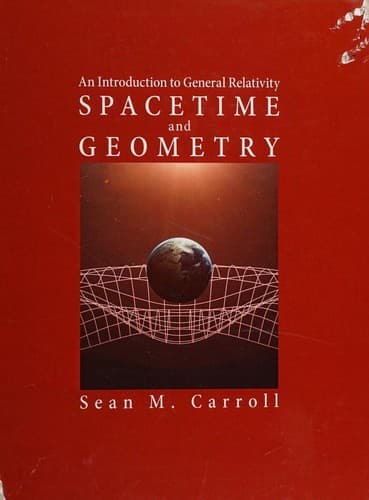
Book details and cover from Google Books.
Ready to read Spacetime and geometry?
Get your copy on Amazon, or listen to it on Audible. We earn a commission if you buy through these links.