
We earn a commission if you buy through these links. Learn more
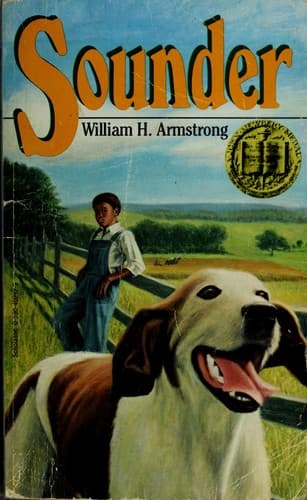
Sounder
A spare, moving novella about a sharecropping family and a boy's long search for his father, showing how dignity and learning can survive hard times.
What It's About
Sounder is a short novel, often read in a single sitting, about a Black family of sharecroppers in the rural South during the Depression. The story centers on a boy who watches his family's hard life closely. A desperate act to feed the household changes everything, and the family's hunting dog, Sounder, becomes a powerful emotional anchor as the boy's journey to find his father drives the story forward.
Armstrong writes in plain, economical sentences that rarely state feelings outright. Much of the emotion comes from what characters do, what they leave unsaid, and small rituals of work, food, and waiting. The prose is quiet rather than melodramatic, so the injustice of the world the family lives in lands through restraint. Readers who want a plot full of twists may find it slow, but the pacing mirrors the boy's own patience and confusion.
The reading experience is closer to sitting with a memory than being swept along. You finish with a clear picture of a place and a people, and with questions about fairness, family, and what education can open up. It works well read aloud and in classrooms, and adults often return to it as a sharp portrait of the period.
Read this if you…
- want a short, emotionally serious novel that adults and older children can share
- are interested in American history told from the perspective of a Black rural family
- want a book that works well for reading aloud, classroom discussion, or a first encounter with hard history
Skip it if you…
- need fast pacing, constant action, or a plot full of surprises
- want a detailed historical study of farm labor, the justice system, or Depression-era economics
Key Ideas
- 1
Dignity under economic pressure
The family is poor and vulnerable to a system built to keep them that way, yet the book refuses to treat them as only victims. Their pride, care for one another, and sense of right and wrong shape every decision. Armstrong asks readers to see ordinary people making hard choices with limited options, and to notice how much dignity persists anyway.
- 2
Family as the center of survival
Everything in the story depends on the household holding together. Separation is the great fear, and the boy's search shows how far a child will go to keep a family connected. The book treats love less as sentiment than as daily labor, the thing that keeps people going when the larger world offers nothing.
- 3
Education as a door out
Learning appears as a quiet but significant force, offering the boy a view beyond the fields. Books and schooling are presented as tools for understanding one's situation, not as a guaranteed escape. The theme is subtle, and it gives the story a hopeful undercurrent without turning it into a lesson.
- 4
Restraint as a storytelling choice
Armstrong's economy with words is the book's signature. Gaps, silences, and small physical details carry more weight than explanation would. Readers who pay attention will notice how the narration trusts them to feel the weight of events, which makes the book feel more honest than a louder account would.
Limitations
The book is brief, so secondary characters and the wider community stay thin, and some readers wish for more depth. Its narrow focus on one family means it offers a limited view of the era. Some readers find its sorrow relentless. Written in 1969, it reflects the framing and language of its moment, and readers looking for more recent perspectives on Black rural life may want to pair it with newer books.
Questions Readers Ask
- Is Sounder appropriate for adults, or only for children?
- Yes. It is classified as children's literature, but its prose is simple while its emotional and historical content is serious. Many adults read it as a first encounter with the subject, and it rewards rereading. Parents should be ready to discuss racism, poverty, and violence with younger readers, since the book addresses them directly without graphic detail.
- How does Sounder compare to Roll of Thunder, Hear My Cry?
- Both are classic novels about Black rural families in the South during the Depression era. Sounder is much shorter and more spare, focusing on one journey and one family crisis. Roll of Thunder, Hear My Cry is longer, with a wider cast and more sustained attention to community life. Readers wanting a quick, intense read should start with Sounder.
- Is Sounder still relevant today?
- Its core themes of family loyalty, dignity, and the unfairness of an unjust system remain powerful. Some of its language and framing reflect the late 1960s, so modern readers may notice gaps in perspective. It is still widely taught, and it remains a useful entry point for conversations about American history and race.
- Published
- 1969
- ISBN
- 9781559946711
- Difficulty
- beginner
- Category
- Children's Books
Book details and cover from Google Books.
Ready to read Sounder?
Get your copy on Amazon, or listen to it on Audible. We earn a commission if you buy through these links.