
We earn a commission if you buy through these links. Learn more
Sophie's Choice
Styron's 1979 novel is a sprawling, emotionally brutal look at love, memory, and survival, told through a young writer who falls into the orbit of two troubled boarders in 1947 Brooklyn.
What It's About
Sophie's Choice (1979) is narrated by Stingo, a young Southern writer who moves to Brooklyn in the summer of 1947 hoping to finish his first novel. He rents a room in a boarding house in Flatbush, where he meets Nathan Landau, a brilliant and mercurial man, and Sophie Zawistowska, a Polish Catholic woman with a guarded manner and a past she will not discuss. Their lives tangle into a relationship that swings between tenderness, cruelty, and absurdity.
William Styron writes in a big, rhetorical, sensuous style. His sentences pile up with clauses and digressions, and Stingo's voice mixes the earnestness of a young man with the knowing hindsight of an older one, so the book reads partly as a memoir about the narrator's own coming of age. Sophie's history surfaces in fragments, usually when she is pushed, and the novel trusts you to assemble the pieces.
Reading it is an immersive and often uncomfortable experience. It moves between comedy, frank sexuality, and grief, and its weight comes from accumulated detail rather than tight plotting. Expect to slow down and stay with long passages, and be ready for the book's emotional demands.
Read this if you…
- want a long, ambitious novel that deals directly with the Holocaust and its aftermath
- enjoy rich, ornate prose and don't mind digressions
- are interested in how memory and narration shape what we believe about the past
Skip it if you…
- want a fast-paced plot or a clear, linear story
- find graphic sexual content or extended emotional cruelty hard to read
Key Ideas
- 1
Memory held back and released slowly
Sophie's past is not delivered as exposition. It leaks out in pieces, shaped by what provokes her and what she can bear to say. The structure makes the reader feel the effort of remembering, and the gaps are as meaningful as the revelations. Much of the book's power lies in watching what people refuse to say.
- 2
A narrator looking back at his younger self
Stingo is not a neutral observer. He is a naive, ambitious, often self-absorbed young writer, and the older voice telling the story is aware of his mistakes. That doubled perspective gives the book a wry, self-critical tone alongside its seriousness, and it asks how much anyone can understand of others when they are still young.
- 3
Love and cruelty in a fragile household
The boarding house relationships are intense, unstable, and often destructive. Desire, jealousy, and dependence shape every encounter, and the characters repeatedly hurt the people they most need. The book treats these entanglements without easy sympathy, which is why they feel so raw.
- 4
Moral weight and the limits of guilt
Styron keeps returning to the question of how a person lives with a past that cannot be put right. The novel does not offer comfort or tidy judgment. Instead it asks what responsibility looks like for those who survived and for those who only heard about atrocity secondhand.
Limitations
Critics have long argued that the novel's central suffering is filtered through a young American man's perspective, which can pull attention toward Stingo's own desires. Styron's ornate, heavily patterned prose is admired by many and found exhausting by others. Some readers have questioned how the book portrays Polish and Jewish characters, and its frank sexual passages have dated uneasily for some. The novel also covers the Holocaust without going deeply into its historical mechanics.
Questions Readers Ask
- Is Sophie's Choice worth reading today?
- Yes, if you are willing to engage with a long, demanding book. Its questions about memory, complicity, and survival remain urgent. The prose is dense and the narration is partial, so it rewards patient reading more than quick consumption. Many readers find it more emotionally affecting than they expected.
- How does the novel compare to the 1982 film?
- The 1982 film with Meryl Streep is a faithful-feeling adaptation of the story's main events, but the novel's voice, digressions, and interior perspective do much of the work that the film cannot easily reproduce. Readers who love the movie often find the book richer. The book is also much more discursive and less focused on its central drama.
- Published
- 1979
- ISBN
- 9781936317189
- Difficulty
- intermediate
- Category
- Fiction
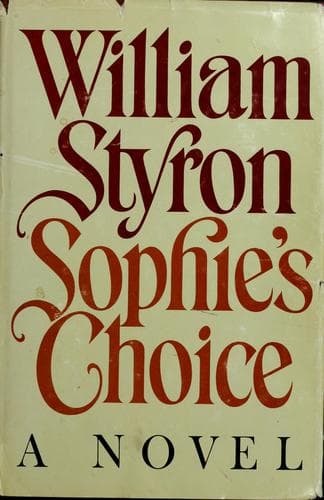
Book details and cover from Google Books.
Ready to read Sophie's Choice?
Get your copy on Amazon, or listen to it on Audible. We earn a commission if you buy through these links.