
We earn a commission if you buy through these links. Learn more
Something Wicked This Way Comes
by Ray Bradbury
Bradbury's lyrical 1962 novel turns a small-town October into a nightmare of temptation and aging, with a carnival that offers what you most want and takes far more.
What It's About
Something Wicked This Way Comes is set in Green Town, Illinois, during a cold October in the late 1920s. Two thirteen-year-old friends, Will Halloway and Jim Nightshade, anchor the story, and it follows them through the night a traveling carnival arrives in the dark, its tents rising before anyone expected it. The carnival, Cooger and Dark's Pandemonium Shadow Show, seems to know the town's secrets, and the boys begin to sense something is wrong long before the adults will admit it.
Bradbury writes in a style closer to prose poetry than to a plot-driven thriller. Sentences roll and stack, metaphors pile up, and the town is evoked through sound, smell, and the feel of autumn. The horror arrives as dread rather than gore, and the pacing is deliberate, with long stretches given over to atmosphere and memory. Readers who want quick cause and effect may find it slow, but those who settle into its rhythm will find it hypnotic.
Reading it feels like sitting by a fire while someone tells a ghost story they half believe. It is a fable as much as a novel, concerned with growing older, with regret, and with the moment a child first sees the weakness in the adults around him. It rewards slow, attentive reading, especially in autumn, and it lingers long after the final pages.
Read this if you…
- want atmospheric, poetic horror that builds through mood more than shocks
- enjoy coming-of-age stories about boys facing fear with a parent's help
- are drawn to dark fables about aging, regret, and the cost of wishes
Skip it if you…
- want fast plot, clear mysteries, or frequent scares
- need fully developed female characters or contemporary social perspectives
Key Ideas
- 1
Temptation as the carnival's currency
Mr. Dark's show trades in wishes, offering each visitor the thing they most secretly crave. The book treats that bargain as the real horror. The danger is not a monster leaping out of the dark but the quiet ache for something you lack, and how easily that ache can be exploited. Bradbury presents temptation as something ordinary, decent people struggle with, which keeps the menace close to home.
- 2
Fear of aging and mortality
Much of the novel's unease comes from time. The carnival's carousel can reverse the years, and the story keeps returning to how people measure their lives by what they have lost. Bradbury turns the fear of getting older into something concrete and frightening, and he does so without much sentimentality, asking what a person would give up to avoid the slow decline of the body.
- 3
Fathers, sons, and the courage to face fear
Charles Halloway, Will's father, is a middle-aged library custodian who is painfully aware of his age and his limits, while Will is the sharper, more watchful boy. Their relationship is the emotional center. The book suggests that bravery is less about feeling unafraid than about doing the next right thing while afraid, and that adults may have to find courage they did not expect to need.
- 4
Bradbury's lyrical, nostalgic prose
The sentences are a large part of the attraction. Long, ornate, and full of simile and rhythm, they make small-town America feel both cozy and haunted. Bradbury's nostalgia for boyhood and his unease about change work together on every page. Readers who love language for its own sake will find passages worth rereading, while readers who prefer spare prose may find the style overwhelming.
- 5
Books and libraries as a refuge
Libraries and reading recur as places of safety and knowledge. The library setting is not mere decoration. The book treats learning and imagination as a form of resistance to the carnival's promise of easy transformation. It makes a gentle case that the slow work of thinking and reading can protect people from the quick solutions that prey on them.
Limitations
Bradbury's style is the book's glory and its biggest risk. The prose is ornate, and many readers find the metaphors pile up until the sense of scene blurs. The middle stretches can feel slow, and the dialogue sometimes leans on speeches. Women characters are thin, and some attitudes about gender and class reflect the book's 1962 origin. The carnival's history and Mr. Dark's motives are also left fairly vague, so readers wanting a fully built mythology may feel shortchanged.
Questions Readers Ask
- Is Something Wicked This Way Comes a children's book?
- It is often shelved in young adult or children's sections because its protagonists are thirteen, and many teenagers read it. Still, its concerns about aging, regret, and grief are adult, and its dense, lyrical prose can challenge younger readers. Many adults return to it, and it works well for teens who enjoy literary horror.
- How does it compare to Stephen King's It?
- Both center on a small town, a group of young friends, and an evil that feeds on fear. King is more propulsive, with a sprawling structure, graphic violence, and a conventional horror pace. Bradbury is shorter, more lyrical, and more interested in mood and moral temptation. If you loved King's atmosphere but want something compact and poetic, Bradbury is a good next step.
- Is it still worth reading today?
- Yes, if you accept its style. Themes of aging, ambition, and the pull of quick fixes remain relevant, and the nostalgia is part of its character rather than a flaw to fix. Expect a mid-century sensibility in gender roles and language. Readers who value lyrical sentences and slow-building dread will find it as haunting as when it first appeared.
- Published
- 1962
- ISBN
- 9780553136951
- Difficulty
- intermediate
- Category
- Fiction
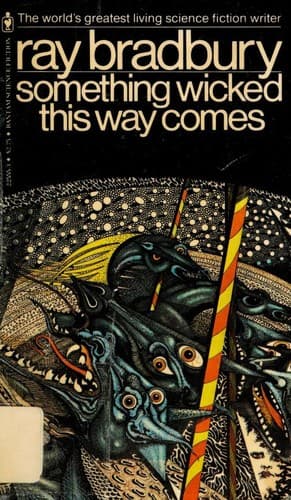
Book details and cover from Google Books.
Ready to read Something Wicked This Way Comes?
Get your copy on Amazon, or listen to it on Audible. We earn a commission if you buy through these links.