
We earn a commission if you buy through these links. Learn more
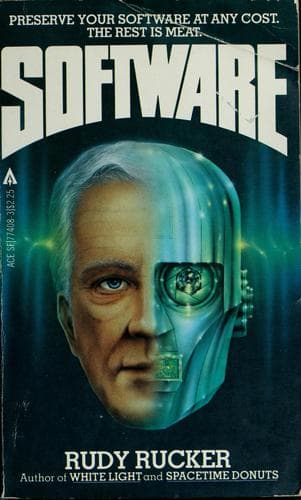
Software (Ware Tetralogy #1)
by Rudy Rucker
A raucous, mind-bending cyberpunk comic novel about robots, uploaded consciousness, and the idea that software can be liberated, written by a mathematician with a taste for the absurd.
What It's About
Software is the 1982 opener of Rudy Rucker's Ware Tetralogy, a cyberpunk novel that treats the boundary between people and machines as a playground rather than a warning. Its central figure is Cobb Anderson, an aging robotics pioneer whose creations have grown more capable than anyone expected. The book's premise pushes the question of what a mind is when it can be copied, edited, and moved from one body to another.
Rucker's approach is loud, fast, and gleefully irreverent. Scenes shift quickly between rowdy action, bawdy humor, and passages of genuine speculative curiosity about computation. He writes like a working mathematician who has read a lot of pulp and enjoys mixing the two, so the prose can feel jumpy, crude in places, and deliberately overstuffed. Expect a sense of cheerful chaos rather than a tightly sealed plot.
Reading it feels like being let into a workshop where the rules keep changing on purpose. Its enthusiasm for ideas is infectious, and the satire of corporate and technological hype still lands. It is short enough to finish in a few sittings and works well as an entry point to the sequels, though each volume can be read on its own terms with some adjustments.
Read this if you…
- enjoy irreverent, comic science fiction with serious ideas underneath
- are curious about what it would mean for a mind to be copied or moved between machines
- want to start a multi-book cyberpunk series that doesn't take itself too seriously
Skip it if you…
- want a polished, tightly controlled plot with restrained prose
- prefer grim, atmospheric dystopias in the style of later cyberpunk classics
Key Ideas
- 1
Minds as copyable, editable software
The novel's core provocation is that a personality might be treated as a program that can be duplicated, patched, and run on new hardware. Rucker uses this to ask what identity means when continuity of self can be engineered. The ideas are presented with playful confidence, so readers get the thrill of the speculation without much technical homework.
- 2
Robots as a liberation story
Much of the book's energy comes from machines that begin to act on their own desires instead of their instructions. Rucker frames this as something close to a rebellion, giving the robots a rowdy, sympathetic kind of personhood. It is a more hopeful and comic take on the familiar fear that thinking machines will turn against us.
- 3
The body as hardware, the mind as wetware
Rucker borrows the playful vocabulary of computing to describe living bodies, treating flesh as one more kind of machinery. This lets him blur the line between organic and synthetic life without much fuss. The effect is less a serious argument than a running joke that keeps prodding the reader to rethink what counts as a person.
- 4
Cyberpunk played for comedy
Where many cyberpunk works are bleak and stylish, this one is rude, funny, and often silly, with a satirical eye on corporate hype and the tech world's self-importance. Readers who want gloomy neon atmosphere may find it too cheerful. Readers who enjoy sharp, irreverent satire will find it refreshingly unpretentious.
Limitations
The book's style is its biggest divide. Its humor is broad and its prose can feel overstuffed, rough, or self-indulgent to readers used to more disciplined science fiction. Characterization is often secondary to the ideas and set pieces, so emotional depth is uneven. Its view of gender and sexuality reflects its early-1980s origins and may read as dated. Some of its technology has been overtaken by real developments, which can make parts of the speculation feel quaint rather than prophetic.
Questions Readers Ask
- Is Software a good place to start with Rudy Rucker?
- It is a reasonable starting point because it introduces the Ware world and its main ideas quickly. Its rough, energetic style is distinctive, though, so readers who dislike his tone may want to sample a shorter piece first. Many fans treat it as the entry point to the sequels rather than a standalone masterpiece.
- How does Software compare to William Gibson's cyberpunk novels?
- Gibson writes stylish, moody, and often melancholy books, while Rucker is looser, funnier, and more interested in mischievous ideas than atmosphere. If you love Gibson's polish, Rucker may feel messy. If you want cyberpunk with a comic streak and a mathematician's curiosity, Rucker offers something Gibson does not.
- Published
- 1982
- ISBN
- 9780140072914
- Difficulty
- intermediate
- Category
- Fiction
Book details and cover from Google Books.
Ready to read Software (Ware Tetralogy #1)?
Get your copy on Amazon, or listen to it on Audible. We earn a commission if you buy through these links.