
We earn a commission if you buy through these links. Learn more
Snow Treasure
Guide by the Books of the Day editors · Updated · How we write our guides
A short, tense wartime adventure that shows how ordinary Norwegian children helped resistance work under German occupation, told in plain language young readers can follow easily.
What Creators Say About Snow Treasure
1 creator reviewed Snow Treasure on YouTube in 2020, with 11.2K views between them. Their opinions are their own; we picked these reviews, we didn't write them.
What It's About
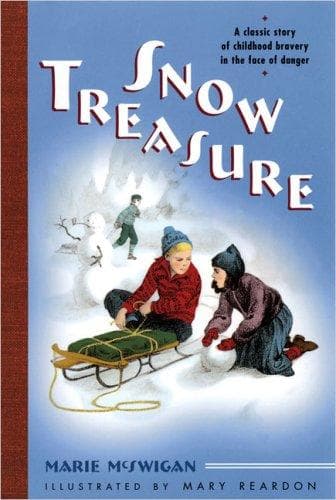
Snow Treasure is a short historical adventure for middle-grade readers, set in Norway during the German occupation of the Second World War. Its premise is based on a real wartime episode in which national gold reserves had to leave the country, and children were used to carry them across snowy terrain toward neutral Sweden. The story centers on a group of young Norwegians who turn an ordinary winter activity, sledding, into cover for something far more dangerous.
Marie McSwigan writes in brisk, uncomplicated sentences with little ornament. The book moves quickly, with most of its scenes built around a single task or obstacle, and it keeps the stakes concrete: a patrol that might look too closely, a load that must get through, a child who must appear calm when it matters most. Characters are drawn broadly, more through their courage and resourcefulness than through inner complexity. Reading it feels like a single afternoon of suspense, well suited to a child who wants to know exactly what is at risk at each step.
Adults reading alongside children will notice the book's age. It was written close to the events it describes, and its tone, its portrayal of the occupiers, and some of its attitudes reflect the 1940s. Even so, as a clear and accessible window onto how everyday people resisted occupation, it remains a useful starting point for a young reader.
Read this if you…
- want a short, fast historical adventure for ages nine to twelve
- are curious about how ordinary people resisted Nazi occupation during the Second World War
- enjoy suspenseful stories where the danger is physical and the plan is clear
Skip it if you…
- want complex characters with deep inner lives or morally tangled choices
- are looking for a detailed, fully researched account of the Norwegian resistance
Key Ideas
- 1
Everyday tasks as cover for resistance
The book's central device is the disguise of play. A sled, a winter outing, or a trip down a hill looks harmless to occupying soldiers, and the children exploit that assumption. The idea that resistance can hide inside ordinary routines is the main lesson, and it gives the plot its steady tension.
- 2
Courage expressed through small, practical acts
Heroism here is not shown in battles or speeches. It consists of staying composed, planning carefully, and doing a dull job well under pressure. Young readers see that bravery is often a matter of keeping your nerve through repetitive, frightening work rather than a single dramatic moment.
- 3
Occupation as constant pressure
The German presence is felt as an everyday fact that shapes movement, speech, and trust. Checkpoints, questioning, and the need to watch what you say give the setting its weight. The book conveys how occupation reaches into ordinary life, which helps younger readers grasp something of its daily reality.
- 4
Loyalty to community and country
The children act not for personal glory but because their families and nation are in danger. Their collective effort, with each child contributing a part, underlines the idea that a community protects itself by working together. This theme gives the story its emotional core without heavy sentiment.
Limitations
The prose is spare, and the characters are drawn with broad strokes, so readers who want psychological depth will find it thin. The book simplifies a complicated historical situation into a clear good-versus-evil frame, and its portrayal of the German occupiers is stereotyped by modern standards. Its wartime outlook and some period attitudes may need explaining to today's children. It is best treated as an entry point to the history rather than a full account of it.
Questions Readers Ask
- Is Snow Treasure based on a true story?
- Yes, the book draws on a real episode from the early years of the German occupation of Norway, when national gold reserves were moved out of the country. The events are simplified and dramatized for young readers, so it works best as a starting point. Adults who want historical precision should look to more detailed nonfiction on the Norwegian resistance afterward.
- What age is Snow Treasure best for?
- It suits roughly nine to twelve, the usual middle-grade range. Its short length, clear structure, and direct language make it accessible to confident readers in that bracket. Younger children can enjoy it read aloud, though some wartime content, such as fear of capture, may need a parent's explanation.
- Published
- 1942
- ISBN
- 9780788737312
- Difficulty
- beginner
- Category
- Children's Books
Book details and cover from Google Books.
Ready to read Snow Treasure?
Get your copy on Amazon, or listen to it on Audible. We earn a commission if you buy through these links.