
We earn a commission if you buy through these links. Learn more
Snow
by Orhan Pamuk
Guide by the Books of the Day editors · Updated · How we write our guides
Pamuk's snowbound novel of a divided Turkish city blends political argument, romance and poetry into a melancholy story about faith, identity and what a writer owes the world.
What Creators Say About Snow
2 creators reviewed Snow on YouTube between 2021 and 2023, with 27.9K views between them. Their opinions are their own; we picked these reviews, we didn't write them.
What It's About
Snow follows Ka, a poet who lives abroad, as he returns to Kars, a remote city in northeastern Turkey near the Armenian and Georgian borders. He has come to report on a wave of suicides among young women caught up in the dispute over headscarves, and he arrives just as heavy snow cuts the town off from the rest of the country. Political tension, a visiting theatre troupe and a brewing military takeover all press in on the people he meets.
Pamuk moves between a close view of Ka's thoughts and a wider, almost documentary narrator who steps back to describe the town, its cafés, its rival factions and its long, argumentative conversations. Poetry, interviews and reconstructed scenes give the book a varied texture, and the plot leans toward thriller at moments without ever becoming a simple chase.
Reading Snow is a slow, absorbing experience. It rewards patience with atmosphere, moral complexity and some sharp humour, and it lingers in the mind long after the snow has melted in the story.
Read this if you…
- Want political fiction that works through character and argument rather than lecture
- Enjoy slow, atmospheric novels set in a single place during a difficult season
- Are curious about Turkey and the tension between secular and religious life
Skip it if you…
- Need a fast plot with steady momentum, since the long debates can stall the story
- Want a neatly resolved narrative or clear answers about Turkish politics
Key Ideas
- 1
Snow as isolation and blank page
The snowfall does more than set the scene. It isolates Kars, muffles the noise of the outside world and turns the town into a kind of blank page on which every faction tries to write its version of events. Pamuk uses the weather to make a provincial city feel like a whole country in miniature, cut off and forced to face its own arguments.
- 2
Secularism and faith in a divided nation
The novel takes seriously the clash between a secular state that sees itself as Western and modern and a religious population that feels pushed to the margins. Pamuk avoids cartoon villains, giving each side believable people with real grievances, so the headscarf dispute becomes a question about belonging and dignity rather than a simple debate.
- 3
The poet as observer and participant
Ka arrives as an outsider who believes poetry should stand above politics, yet the town keeps pulling him into its conflicts. The book asks whether a writer can remain a neutral witness, and what it costs to care about a place and its people. This tension gives Ka's chapters their emotional and moral weight.
- 4
Theatre and performance as politics
Public life in Kars often looks like a staged performance, with actors, speeches, rumours and rehearsed roles. Pamuk returns repeatedly to the idea that identity is partly acted out, and that the line between sincere conviction and show can blur under pressure. Readers who enjoy books about performance will notice how carefully this theme is built into the story.
- 5
Love and the lives not chosen
Ka's romance with a woman in the town offers a more personal thread through the political material. It explores longing, the pull of a simpler life and the sense of paths not taken. The love story is quieter than the politics but keeps the book grounded in individual feeling.
Limitations
The novel is long and often talky, and its political debates can feel repetitive to readers who are not drawn to ideas for their own sake. Some characters work more as positions in an argument than as fully rounded people. Readers unfamiliar with Turkish history from the early 2000s may need background to follow the stakes of the headscarf dispute and the military tensions. English translation carries the prose well, but some wordplay and cultural nuance is inevitably lost.
Questions Readers Ask
- Is Snow a good first book by Orhan Pamuk?
- Many readers start with My Name Is Red or The Museum of Innocence, which are often considered more accessible entry points. Snow suits readers who already want Pamuk's engagement with politics and identity, and it is a strong choice for those who like the sound of a book about a divided city. Starting here is fine if the premise appeals to you.
- Is Snow still relevant today?
- Yes. The tension between secular institutions and religious life that drives the novel's central conflict remains a live question in Turkey and in many other countries. Pamuk's focus on how ordinary people experience ideological pressure makes the book feel current, even though its events are tied to a specific moment in Turkish history.
- Published
- 2002
- ISBN
- 9780571222995
- Difficulty
- intermediate
- Category
- Fiction
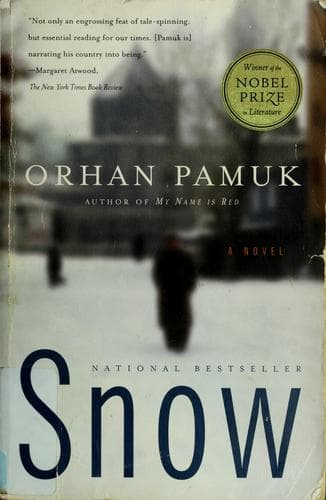
Book details and cover from Google Books.
Ready to read Snow?
Get your copy on Amazon, or listen to it on Audible. We earn a commission if you buy through these links.