
We earn a commission if you buy through these links. Learn more
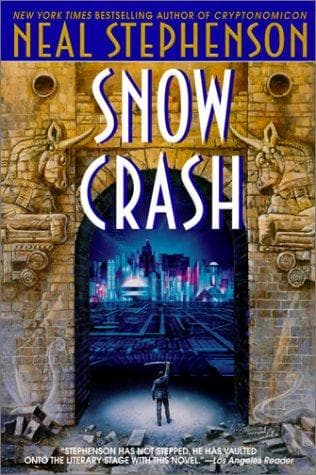
Snow Crash
A fast, funny cyberpunk satire of franchised cities, Mafia-run pizza delivery, and a digital drug that jumps from screens into skulls, with a sword-wielding hacker at its center.
What It's About
Snow Crash, published in 1992, imagines a near future in which the United States has broken into corporate enclaves and franchised city-states, and where ordinary public services have been handed to private brands. Hiro Protagonist is a hacker and freelance swordsman who delivers pizza for a franchise run by a mafia-style family. When a drug called Snow Crash begins to spread through the Metaverse, a shared virtual street, and into the physical world, Hiro teams up with Y.T., a fifteen-year-old courier, to chase down its source.
Stephenson writes in a loud, funny, digressive voice. Action scenes move quickly and cinematically, but the story regularly stops for lectures on Sumerian myth, linguistics, and the history of computing, delivered with a sly grin. Chapters alternate between Hiro and Y.T., and the satire of consumer culture, religion, and corporate power is the real engine of the book, more than any single mystery.
Expect an energetic, idea-heavy book rather than a precise one. Many of its predictions about avatars, online commerce, and virtual public space read as prescient today, which gives the book a second life as a historical document. Readers who like their science fiction tidy may find it shaggy, but those who enjoy a writer who clearly loves his obsessions will find it hard to put down.
Read this if you…
- enjoy comic science fiction with sharp satire of corporations and religion
- want to see where the virtual-world idea that later books and games borrowed first took shape
- like fast, cinematic action mixed with digressive, know-it-all asides
Skip it if you…
- want a tightly plotted thriller with restrained, precise prose
- are put off by crude humor, graphic violence, or long tangents on history and linguistics
Key Ideas
- 1
Ideas as infectious software
Stephenson treats language, myth, and belief as a kind of code that runs on human brains. Drawing on the Tower of Babel and older Mesopotamian stories, the book suggests that a well-built phrase or ritual can spread and take control of people much as a computer virus takes over a machine. The drug at the center of the plot is the most literal version of this idea, but the metaphor runs through the entire book.
- 2
A country run by franchises
The United States has largely dissolved into private enclaves, franchised city-states, and corporate-run zones. Public life is organized around brands, and even organized crime has been turned into a business model with a logo. Stephenson uses this setting to satirize consumer culture and the way corporations take over functions once handled by governments, making a joke of the nation-state without fully abandoning its stakes.
- 3
The Metaverse as public space
The Metaverse is a virtual reality street where people meet as avatars, and its look and rules are shaped by who can afford better hardware. Stephenson treats it as a real public place with its own economy and class divisions, not an escape from the world. This framing feels remarkably current when read against today's social platforms and virtual worlds, and it is one reason the book's influence on later science fiction and games is so often discussed.
- 4
Two very different protagonists
Hiro is a brilliant, quick-witted hacker who has retreated into his own myth, while Y.T. is a tough, resourceful teenager who knows the streets better than any system. Their chapters alternate, and the contrast between Hiro's grand self-image and Y.T.'s practical energy gives the book much of its warmth and humor. Their relationship, more than the plot, is what keeps many readers coming back.
Limitations
Snow Crash has aged in some ways that matter. Its portrayal of Japanese characters and culture leans on stereotypes that many readers find uncomfortable, and women outside Y.T. are mostly thin or peripheral. The prose is loud and joke-heavy, and the long lectures on Sumerian myth, linguistics, and computing can stall the pace for readers who came for the chase. The cyberpunk tech vocabulary also dates, though the core ideas hold up better than the gadgets.
Questions Readers Ask
- Is Snow Crash still worth reading now that virtual worlds are common?
- Yes, though it reads differently now. The avatars, online commerce, and corporate-run public spaces it imagined feel familiar, so the book works as a sharp historical document as well as a fun story. The jokes and digressions carry it more than the futuristic gadgets, and those still land.
- How does Snow Crash compare to William Gibson's Neuromancer?
- Neuromancer is moodier, sleeker, and more lyrical, with a noir feel and a colder view of technology. Snow Crash is funnier, louder, and more openly satirical, with a rapid-fire voice and a willingness to stop and explain its ideas. If you liked Gibson's atmosphere, expect a different temperament here.
- Do I need to know cyberpunk or computing to enjoy it?
- No. Stephenson explains what he needs as he goes, and the humor makes the jargon easy to follow. A general reader who enjoys action comedy will get a lot out of it, though technically minded readers may enjoy the asides more.
- Published
- 1992
- ISBN
- 9780593599730
- Difficulty
- intermediate
- Category
- Science Fiction
Book details and cover from Google Books.
Ready to read Snow Crash?
Get your copy on Amazon, or listen to it on Audible. We earn a commission if you buy through these links.