
We earn a commission if you buy through these links. Learn more
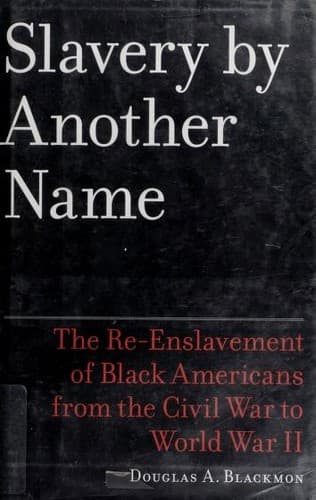
Slavery by another name
by Douglas A. Blackmon, Dennis Boutsikaris
Guide by the Books of the Day editors · Updated · How we write our guides
A Pulitzer-winning account of how Southern states rebuilt forced Black labor after emancipation through convict leasing and debt peonage, told through archival records and individual lives.
What It's About
Douglas A. Blackmon, a Wall Street Journal reporter, spent years in court records, prison files, and company archives documenting a system that outlasted slavery by roughly eight decades. Between the Civil War and the Second World War, Southern courts and sheriffs arrested Black men on minor or invented charges, fined them, and then sold their labor to mines, railroads, lumber camps, and farms. Debt, violence, and vagrancy laws kept many of them working for years, sometimes until death. The book's focus is heavily on Alabama, though it ranges more widely.
The approach is narrative history. Blackmon moves between individual stories and the larger economic and political machinery, so one man's arrest sits beside an account of a company's balance sheet. The reading experience is sobering and often angry, but it is also careful about evidence, grounding its claims in documents and the voices they preserve. Expect a long, dense book that asks you to sit with specific cruelty rather than skim summaries.
Despite the Tech category on this listing, this is a work of American history, not technology. It is narrower than some readers expect, centered on labor coercion and the arrangements between states and private employers behind it rather than on Reconstruction politics as a whole. Its structure rewards patience, and it works well alongside other histories of the period.
Read this if you…
- want a detailed, evidence-based account of how the end of slavery was followed by new forms of forced labor
- are interested in how states and companies profited from the convict and debt labor systems
- can handle sustained accounts of racial violence and want history that names the institutions responsible
Skip it if you…
- want a broad overview of Reconstruction politics or civil rights law
- need a light, fast read, since this book is long and dense and can be grim for long stretches
Key Ideas
- 1
Emancipation did not end coerced labor
Blackmon argues that abolition was followed by a set of legal and economic tools that recreated forced work. Vagrancy and petty theft laws, along with fines that prisoners could not pay, funneled Black men into a system where the state sold their labor to private employers. The argument reframes the decades after the war as a continuation rather than a break.
- 2
Convict leasing as a profit engine
States leased prisoners to mines, railroads, and timber operators, generating money for governments and companies alike. Because both benefited, reform efforts struggled to gain traction. The book shows how an apparently administrative practice became an economic arrangement with powerful stakeholders invested in keeping it running.
- 3
Debt peonage as a quieter trap
Workers on farms and in company camps were kept in debt through inflated accounts and company stores. Contract and debt laws could then turn an attempt to leave into a crime. Blackmon shows how this mechanism operated without visible chains, which made it harder to recognize and challenge.
- 4
Individual lives behind the statistics
Case files, prison records, and letters let Blackmon trace specific people through the system. These stories make the scale concrete and keep the reader from treating the victims as abstractions. The method is central to why the book is so affecting, and also why it reads more like a chronicle than a survey.
Limitations
Critics have questioned the book's scale and some of its framing. They argue that these practices varied more across the South than the narrative suggests and that the Alabama focus can stand in for the whole region. Some historians also felt the book leans on dramatic individual stories more than systematic analysis. It gives limited space to Black resistance and organizing, to the labor movement, and to how the system differed from state to state. Treat it as a powerful account of one system rather than a complete history of Black labor after emancipation.
Questions Readers Ask
- Is Slavery by Another Name still relevant?
- Yes. Its subject is historical, but its questions about how criminal justice and private labor interests can combine remain current. Many readers come to it after debates about mass incarceration. Because the book does not cover later developments, pair it with newer scholarship for the decades after the 1940s.
- How does it compare to The New Jim Crow?
- Michelle Alexander's The New Jim Crow argues about mass incarceration today through a legal and political lens. Blackmon is the historian, documenting in granular detail how convict leasing and peonage worked in the decades after the Civil War. Readers who finish one often want the other, though Blackmon is the better choice if you want the past itself.
- Published
- 2008
- ISBN
- 9781848314122
- Difficulty
- intermediate
- Category
- Tech
Book details and cover from Google Books.
Ready to read Slavery by another name?
Get your copy on Amazon, or listen to it on Audible. We earn a commission if you buy through these links.