
We earn a commission if you buy through these links. Learn more
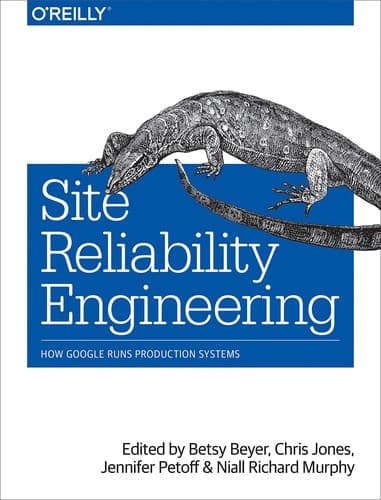
Site Reliability Engineering
by Betsy Beyer, Jones, Chris (Computer engineer)
Guide by the Books of the Day editors · Updated · How we write our guides
The Google engineering handbook for keeping large services reliable, covering service level objectives, error budgets, and eliminating toil, written by many of the engineers who run it.
What Creators Say About Site Reliability Engineering
1 creator reviewed Site Reliability Engineering on YouTube in 2026, with 187 views between them. Their opinions are their own; we picked these reviews, we didn't write them.
What It's About
Site Reliability Engineering is a collection of essays from Google engineers describing how they run their production systems. It grew out of the idea that operations work can be treated as a software problem: staff a team with engineers who write code, cap the amount of manual work they do, and give them the authority and data to make systems more dependable. The book is less a tutorial than a field report, organized around the principles and practices that emerged from that approach.
Reading it feels like sitting in on internal design reviews. Chapters move between high-level philosophy and concrete mechanisms, and many sections are written as case discussions rather than step-by-step instructions. Expect dense passages on monitoring, load handling, and failure modes alongside lighter pieces on team culture and postmortems. The writing is direct and mostly free of jargon for its own sake, though it assumes you already know what a load balancer or a distributed database does.
Because it documents one company's scale and tooling, the lessons are easier to adapt than the specifics. Most readers come away with a clearer vocabulary for reliability trade-offs and a set of practices they can scale down to a much smaller operation. It rewards reading slowly and returning to sections as systems get harder.
Read this if you…
- run or design production services and want a shared vocabulary for reliability
- are an engineering manager deciding how much to invest in stability and on-call health
- want to see how a large company handles incidents, monitoring, and releases in practice
Skip it if you…
- mostly want a hands-on runbook or a cloud-specific tutorial
- work far from production systems and want a general business or management book
Key Ideas
- 1
Reliability is a feature you budget for
Service level objectives set a target for how often a service should work well, and the gap between that target and perfection becomes an error budget. When the budget is spent, teams slow feature launches and focus on stability. This turns an argument between developers and operators into a shared, measurable decision that both sides can accept.
- 2
Keep manual operational work, or toil, small
Toil is repetitive, manual work tied to running a service that tends to grow with traffic rather than leaving lasting value behind. The book suggests capping the share of time engineers spend on it and automating what remains. The aim is for people doing operations to spend most of their time on projects that make the system better.
- 3
Page humans only for problems that matter
Alerts should signal conditions that need a person to act now, such as users actually failing, while trends and diagnostic detail belong in dashboards and logs. Symptom-based alerting generally beats an ever-growing list of internal causes. The book argues that simple, well-understood monitoring is more valuable than elaborate systems nobody trusts.
- 4
Learn from incidents without blaming people
Blameless postmortems focus on what happened and how systems and processes allowed it to happen, rather than on who made the error. Incident response roles, clear communication during outages, and written follow-ups are treated as skills a team can practice and improve. The goal is to make the next failure less likely, not to find someone to punish.
- 5
Design for overload and gradual degradation
Cascading failures, retry storms, and overloaded backends are common ways a small problem grows into a major outage. The book discusses approaches such as shedding excess load, degrading features gracefully, and rolling out changes carefully to limit how far a fault can spread. These ideas matter most for anyone running systems that many other systems depend on.
Limitations
The book describes Google's scale, internal tooling, and culture, and many practices assume infrastructure that small teams do not have. Some chapters read as collections of contributed essays, with uneven depth and some repetition. Because it was written around 2016, newer areas such as cloud-native platforms and container orchestration are treated only lightly or not at all. It is not a substitute for hands-on experience, and readers looking for step-by-step guidance will need to look elsewhere.
Questions Readers Ask
- Do I need Google-scale systems to benefit from this book?
- No. The core ideas, such as error budgets, toil limits, and blameless reviews, apply to teams of a few people. Expect to translate the specifics, like the tooling and staffing details, into your own context. Engineers who have run any live service will find the reasoning easiest to follow.
- How does it compare with The Site Reliability Workbook?
- The Workbook is a companion volume that focuses more on practical application, with worked examples and implementation guidance. The original book is stronger on principles and the reasoning behind them. Many readers start here and move to the Workbook when they want to put the ideas into practice.
- Is it still relevant today?
- The principles hold up well because they concern how people and systems behave under pressure, not specific products. Some tooling references are dated, and cloud platforms have changed much of the day-to-day work. Treat the examples as history and the underlying ideas as current.
- Published
- 2016
- ISBN
- 9781491929124
- Difficulty
- intermediate
- Category
- Business
Book details and cover from Google Books.
Ready to read Site Reliability Engineering?
Get your copy on Amazon, or listen to it on Audible. We earn a commission if you buy through these links.