
We earn a commission if you buy through these links. Learn more
Sit-in
A picture book that makes the 1960 Greensboro lunch counter sit-in understandable to young readers, showing how four students changed history by refusing to leave their seats.
What It's About
Sit-In is a picture book about the February 1960 protest in Greensboro, North Carolina, when four Black college students sat down at a whites-only Woolworth's lunch counter and asked to be served. It is written for young readers, roughly early elementary age, and it treats the event as a story about ordinary people choosing to act rather than as a lesson in dates and laws.
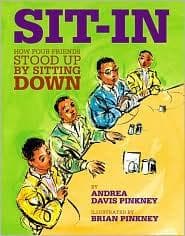
The book's approach depends on pairing text and pictures. Andrea Davis Pinkney's prose is spare and rhythmic, built to be read aloud, while her longtime collaborator Brian Pinkney's illustrations, done in a loose, textured style with soft color, carry much of the emotional weight: the tension at the counter, the stares, the long wait. Adults should expect a short read, usually finished in one sitting, with room for questions afterward.
The experience is closer to a shared moment with a child than to a textbook. It works best as a first introduction to civil rights history or as a companion to longer material, because it trades detail for feeling. Readers who want the wider movement, the legal background, or what followed the sit-ins will need to look elsewhere.
Read this if you…
- want a gentle, age-appropriate introduction to the Greensboro sit-ins for a child
- are reading with a young child and want a story that invites conversation about fairness
- appreciate picture books where the art and text share the storytelling
Skip it if you…
- want a detailed historical account of the civil rights movement or the sit-in campaign
- are looking for a long narrative or chapter-based reading experience
Key Ideas
- 1
Ordinary people as the engine of change
The book centers on four young men who were not famous leaders. Their courage comes from everyday decisions made with friends, which makes the history feel reachable for children who might assume only adults can change anything.
- 2
Refusal as a form of action
The protest is powerful because it asks very little of the people involved: they simply stay seated. The book shows how stillness and persistence can be a deliberate, public statement against an unjust rule.
- 3
Dignity under humiliation
The story keeps its attention on how it feels to be refused service for the color of one's skin. It conveys injustice and resolve without dwelling on graphic violence, which suits its young audience.
- 4
Illustration doing emotional work
Much of the meaning sits in the pictures rather than the words. Brian Pinkney's art slows the moment down and lets readers see faces, posture, and the crowded room, so the text can stay brief and the feeling lands clearly.
Limitations
As a short picture book, Sit-In necessarily simplifies a complicated period. It does not explore the broader sit-in movement across the South, the legal and political context of segregation, or the longer effects of the protest, so adults may want to supplement it. Some readers may find the text too brief or the language too young for older children who are already studying the period. The book's emotional approach also means it leans toward feeling over analysis, which some teachers and parents will see as a strength and others as a limit.
Questions Readers Ask
- What age is Sit-In best for?
- It is generally aimed at young elementary-age children, roughly five to nine, though older readers and adults often find it moving. The subject, racial segregation, is presented plainly with a calm tone and no graphic scenes, so it suits classroom and family reading. Adults reading it aloud can pause to explain terms like segregation as needed.
- Is Sit-In still relevant today?
- Yes. The book's core subject, ordinary people refusing to accept unjust treatment, remains widely taught and discussed. Its focus on nonviolent protest and dignity makes it useful for conversations about civic courage, though readers should expect it to introduce history rather than analyze current events.
- Should I read Sit-In or a longer history of the sit-ins?
- Read Sit-In first if you want an accessible, emotional entry point, especially with children. If you want context, sequence, and the wider movement, a longer nonfiction account is the better next step. Many readers find that reading the picture book first makes the longer history easier to follow.
- Published
- 2010
- ISBN
- 9780316086653
- Difficulty
- beginner
- Category
- Children's Books
Book details and cover from Google Books.
Ready to read Sit-in?
Get your copy on Amazon, or listen to it on Audible. We earn a commission if you buy through these links.