
We earn a commission if you buy through these links. Learn more
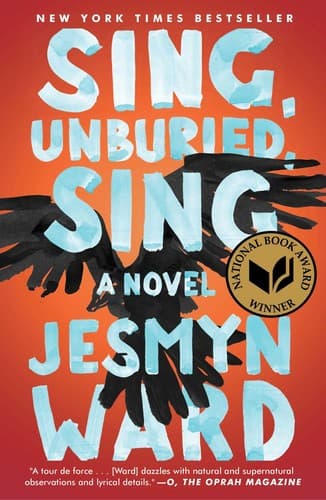
Sing, Unburied, Sing
by Jesmyn Ward
A lyrical, haunting Southern novel about a teenager, his fractured family, and a ghost who rides along on a prison road trip. Demanding, rewarding, and hard to shake.
What It's About
Sing, Unburied, Sing is a novel about a Black family on the Gulf Coast of Mississippi, told mostly through thirteen-year-old Jojo. He is raising his little sister while his mother, Leonie, is often absent and his grandparents are failing. The pressure point is a long drive to a state prison to collect Jojo's father, a white man, who is about to be released. Along the way, a dead boy who was once locked up with his father keeps appearing to the family, so the trip becomes a journey through memory as much as geography.
Ward moves among several narrators, including Jojo, Leonie, and the ghost, Richie. Each voice has its own rhythm, and the shifts can feel like being pulled into someone's head mid-thought. The prose is lyrical and often run-on, packed with heat, sickness, and bodily detail. Dialogue carries Southern speech without heavy phonetic spelling, and the grief and hunger in the household are rendered physically rather than explained.
Reading it is an emotional, sometimes punishing experience rather than a plot-driven one. The book asks you to sit with a family under strain and with the weight of racism, incarceration, and loss passed down through generations. It rewards patience. Expect to slow down, reread passages, and let the supernatural elements sit alongside the realism without being explained.
Read this if you…
- want a lyrical, emotionally demanding novel about race and family in the rural South
- enjoyed the haunted, multigenerational family dramas of Faulkner or Toni Morrison and want something more recent
- are happy with a road novel where the real journey is interior
Skip it if you…
- need a fast plot, a clear mystery, or a tidy resolution
- find shifting narrators, dense run-on prose, or ghosts that speak in the present tense disorienting rather than rewarding
Key Ideas
- 1
Inherited loss passed through generations
Jojo, Leonie, and their grandparents each carry wounds they inherited from earlier family members. Much of the novel is about silences, half-told histories, and the ways grief and shame move from one generation to the next. The ghost makes these inheritances visible by insisting that the past be spoken aloud.
- 2
Prison as a force inside the household
Incarceration is not a distant event in this book. Jojo's father's imprisonment shapes his daily life, his mother's choices, and his sense of who he is allowed to become. Ward treats the prison system as something that reaches into children's lives long before and long after anyone is locked away.
- 3
Ghosts as memory rather than spectacle
Richie's presence is less a horror device than a way of carrying unresolved trauma into the present. His ghost speaks from a past that was never properly acknowledged. Readers who expect a traditional ghost story may find the haunting quieter and more mournful than they anticipate.
- 4
Shifting voices that complicate judgment
Leonie's sections show a struggling, frightened mother whose failures are real but not simple. Switching between narrators prevents any single perspective from becoming the final word, so readers must weigh competing accounts of the same family and its pain.
- 5
Lyrical prose that refuses easy comfort
The sentences are dense, sensory, and emotionally direct, and Ward lets images of the body, the land, and the storm accumulate. The style is what gives the novel its power, but it also asks for close attention and can feel exhausting over a long reading session.
Limitations
Some readers find the ghost device heavy-handed, and the supernatural strand can feel like it sits uneasily beside the realism. The prose is intense for long stretches, and some critics feel the emotional register stays at a high pitch for too long. Several family arcs, particularly those of the grandparents and the mother, can feel compressed. The novel is also tightly focused on one family, so it does not offer a broad survey of Mississippi history or the wider prison system.
Questions Readers Ask
- Is Sing, Unburied, Sing a good first Jesmyn Ward novel?
- It is a strong entry point because it is her most widely discussed recent novel and shows her signature style fully. If you prefer a more immediate, tightly paced story, her earlier novel Salvage the Bones covers similar Gulf Coast ground and is often recommended first. Either book works, and reading one tends to make the other richer.
- Is the book too bleak to enjoy?
- It is bleak, with violence, addiction, poverty, and death at its center. But it is also tender, especially in its portrait of Jojo's bond with his sister and his love for his grandparents. Readers who can tolerate heavy material will likely find it moving rather than simply grim.
- How does it compare to Faulkner?
- Ward draws on the Southern Gothic tradition that Faulkner helped define, including the weight of the past and the presence of the dead. Her sentences feel more immediate and less formally experimental, and her focus on a Black family in the present gives the haunting a different urgency.
- Published
- 2017
- ISBN
- 9781501126079
- Difficulty
- intermediate
- Category
- Fiction
Book details and cover from Google Books.
Ready to read Sing, Unburied, Sing?
Get your copy on Amazon, or listen to it on Audible. We earn a commission if you buy through these links.