
We earn a commission if you buy through these links. Learn more
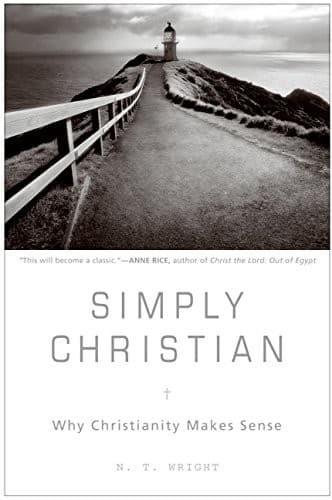
Simply Christian
by N. T. Wright
A bishop's plain-spoken case that Christianity answers the questions people actually ask about justice, meaning, and Jesus, written for readers with no church background.
What It's About
Simply Christian is N. T. Wright's attempt to explain the Christian faith to people who have never had reason to take it seriously, or who think they already know what it says and have dismissed it. Wright, a New Testament scholar who served as Bishop of Durham, starts from the everyday questions behind the faith: why the world seems both beautiful and broken, why people long for justice and meaning, and what there is to say about Jesus. He sets the familiar answers beside the story the Bible tells and asks which one holds together.
The style is conversational and direct. Wright writes like a teacher who would rather argue than lecture, pausing to take objections seriously and to show how the Christian story looks from different angles. The argument is short and built to be read through in a few sittings, with little technical vocabulary and few footnotes. The tone is warm but confident, and Wright does not hide that he is making a case.
Reading it is less like studying theology than like overhearing a long, friendly argument with a sceptic. Some sections feel quick and sweeping, while others slow down to examine the resurrection and the idea of new creation in more depth. Readers who come expecting a neutral survey of world religions will be surprised by how openly it argues for one view.
Read this if you…
- are curious about Christianity but put off by church language
- want a serious, readable case for the faith from a scholar who takes the Bible seriously
- are a sceptic willing to be argued with rather than simply reassured
Skip it if you…
- want a neutral comparison of world religions or a purely critical historical review
- are looking for devotional comfort, or expect a book that treats doubt as something to avoid
Key Ideas
- 1
The longing behind the big questions
Wright treats human hunger for meaning, justice, beauty, and relationship as clues worth taking seriously rather than noise to be explained away. He asks what would have to be true of the world for these longings to make sense, and uses that question to open the door to the Christian account.
- 2
Jesus as the hinge of the story
He argues that the claims about Jesus, especially his death and resurrection, are the point on which the rest of the faith turns. These claims are read in their first-century Jewish setting rather than as later religious abstractions, which is a central move in his wider work.
- 3
Creation, disorder, and God's renewal
Christianity presents the world as good but damaged, and its hope is not escape from the physical world but the renewal of creation under God's rule. Wright uses this picture to explain why Christians care about justice and the material world, not only about private salvation.
- 4
Belief expressed through practice
Wright connects belief to prayer, worship, life in the church, and the work of healing and justice in the present. The book presents Christian life as participation in what God is already doing, rather than as a set of opinions to be agreed with.
Limitations
Wright writes from within the Anglican tradition and from a confident Christian position, so readers who are not sympathetic will find the argument one-sided. Critics have said that it presents debated historical claims, especially about the resurrection, with more certainty than the evidence supports. The book is short and cannot treat every objection in depth, and some of its cultural references feel dated. Its reading of the Bible reflects a particular scholarly view that many other scholars and believers would question.
Questions Readers Ask
- Do I need to know anything about Christianity first?
- No. Wright assumes curiosity rather than background and explains his terms as he goes. Readers who grew up in church may find parts of it familiar, but the book is aimed at people starting from outside. It works well as a first serious book on the faith, though it rewards readers who think through the arguments rather than skim them.
- How does it compare with Mere Christianity?
- Both are popular defences of the faith aimed at general readers, but they differ in approach. C. S. Lewis reasons through moral and philosophical arguments in an essayistic way, while Wright draws more heavily on the biblical story and on history. If you want philosophy and argument from reason, Lewis may suit you better. If you want the Bible's narrative at the centre, Wright is the more natural choice.
- Published
- 2006
- ISBN
- 9780060507152
- Difficulty
- beginner
- Category
- Christianity
Book details and cover from Google Books.
Ready to read Simply Christian?
Get your copy on Amazon, or listen to it on Audible. We earn a commission if you buy through these links.