
We earn a commission if you buy through these links. Learn more
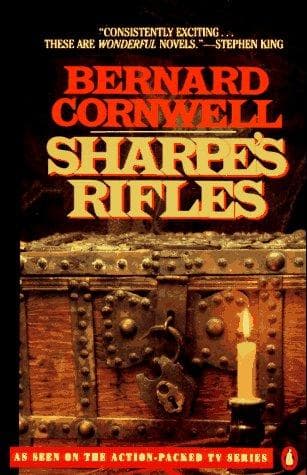
Sharpe's Rifles
by Bernard Cornwell, Frederick Davidson
A fast, character-driven Napoleonic war adventure in which a rough, capable rifleman who rose from the ranks shows why the Sharpe series became so popular.
What It's About
Sharpe's Rifles is historical adventure fiction, not history, despite the category it has been filed under. It is set during the Peninsular War and centres on Richard Sharpe, a former private who has been promoted into the officer class and is never fully at ease among his social superiors. Bernard Cornwell's aim is to put the reader on the ground with the men: the long marches, the cold and mud, the fear before a fight, and the petty politics and rivalries of army life. The historical setting is researched with care, and real campaigns and military details give the story its frame.
The writing is quick and muscular, with short chapters, sharp dialogue, and action scenes told from close to the fighting. Cornwell mixes invented characters and episodes with real events, so part of the pleasure is noticing where the record ends and the invention begins. The rifle tactics of light infantry, a less familiar corner of the period, give the book much of its texture and its sense of how these soldiers thought and fought.
Reading it feels like watching a well-made war film: propulsive, direct, and more interested in courage, loyalty, and survival than in high-level strategy. It suits readers who enjoy a hero who is competent, a little rough, and frequently at odds with authority. Those who want deep interior reflection or a broad view of the war may find the pace and focus narrower than they would like.
Read this if you…
- enjoy fast-paced historical adventure with a battle-tested hero
- want a Napoleonic-era story that focuses on ordinary soldiers rather than generals
- like war fiction that is gritty, practical, and direct rather than lyrical
Skip it if you…
- want a literary novel with deep psychological interiority or slow, reflective prose
- are looking for a history of the Peninsular War or the Napoleonic campaigns, since this is fiction
Key Ideas
- 1
Class and merit in the British army
Sharpe's rise from the ranks gives the book its central tension. He is respected for what he can do in a fight but treated with suspicion by officers who inherited their place. Cornwell uses this friction to show how the army's social order shaped who got opportunities, who was blamed, and who was trusted when things went wrong.
- 2
Light infantry and the rifle as a weapon
The title points to the riflemen, soldiers who fought differently from the line regiments. They moved in looser formations, picked off officers, and relied on individual judgement. The book gives a practical feel for their skills, their pride, and the way their methods set them apart from the massed volley fire of the regular infantry.
- 3
Loyalty and bonds between fighting men
Much of the emotional weight comes from the relationships between Sharpe and the men who follow him. Trust is earned through shared danger rather than rank. Cornwell returns often to this idea, showing how small units held together under pressure and why men were willing to risk their lives for one another.
- 4
War as seen from the ground
The book keeps its focus at the level of the individual soldier and small unit. Grand strategy appears only at the edges, through orders, rumours, and consequences. This narrow view is a deliberate choice that makes battles feel immediate and confusing, the way they probably felt to people actually caught up in them.
Limitations
Cornwell's style is brisk and plot-driven, so character development is often secondary to action, and some readers find the hero's competence and bravado more cartoonish than convincing. The book's view of the war is narrow and centred on British infantry, leaving the French and Spanish perspectives largely offstage. Some period attitudes, including those toward class, women, and the people of occupied territories, reflect the era and the genre more than a modern outlook, and readers should expect them.
Questions Readers Ask
- Is Sharpe's Rifles a history book or a novel?
- It is a novel. Although it is set during real events of the Peninsular War and draws on real military detail, the central characters and many episodes are invented. It is best read as historical fiction, and readers who want an accurate account of the war should look to dedicated histories alongside it.
- Do I need to read the other Sharpe books first?
- Not necessarily. Cornwell's series can be read in several orders, and this book works as a self-contained adventure with enough context for a new reader. Readers who want Sharpe's full career in chronological order may prefer to check a reading-order guide, since the books were not published in historical sequence.
- How does it compare to Patrick O'Brian's novels?
- Both are historical adventures set in the Napoleonic era, but they differ in tone. Cornwell's book is more direct and action-led, with a clear hero and a driving plot. O'Brian's Aubrey and Maturin novels are slower, more witty, and more concerned with period detail and character. Readers who enjoy one will often find something to like in the other.
- Published
- 1988
- ISBN
- 9780007338733
- Difficulty
- beginner
- Category
- History
Book details and cover from Google Books.
Ready to read Sharpe's Rifles?
Get your copy on Amazon, or listen to it on Audible. We earn a commission if you buy through these links.