
We earn a commission if you buy through these links. Learn more
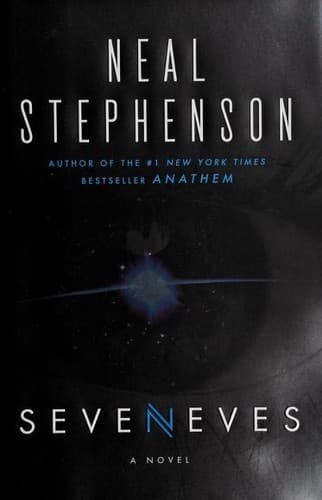
Seveneves
Seveneves is a hard-science survival epic that treats the end of the world as an engineering and politics problem, spanning millennia with brisk, wry storytelling.
What It's About
Seveneves opens with a catastrophe that leaves humanity only a short window to respond. Its first stretch is a tense, practical race: scientists, engineers, and governments have to work out how to keep people alive while the planet faces a long period of hazard. Stephenson takes the logistics seriously, so much of the book is about orbital mechanics, life support, materials, and the hard arithmetic of who can physically be saved.
The prose is brisk, dry, and often funny, with a wide-angle narrator who moves between many characters and jumps forward in time. Dialogue carries a lot of the exposition, and the book is happy to pause for long technical discussions that some readers will find thrilling and others will find slow. Its tone is closer to a thought experiment with human stakes than to a conventional thriller.
Reading Seveneves feels like settling in for a long project. The early sections are the most gripping. Later parts become more speculative and cover far more time, so the experience shifts from crisis drama to something more like a sweeping chronicle. It rewards patience and curiosity about how societies and bodies adapt, more than it rewards attachment to any single character.
Read this if you…
- enjoy hard science and long technical passages that explain how things actually work
- like big, ambitious science fiction that asks what survival and civilization would really demand
- are comfortable with a large cast and a narrator who moves across decades and generations
Skip it if you…
- want a tight, character-driven novel with a single protagonist and steady emotional focus
- find extended technical explanation tedious and prefer speculation kept light
Key Ideas
- 1
Survival as an engineering problem
The book treats rescue as a series of concrete tasks: building shelter in orbit, keeping air and water cycling, manufacturing enough material, and doing it all on a deadline. Much of the pleasure lies in watching competent people reason through constraints step by step, and in seeing how small technical choices carry large human consequences.
- 2
The politics of who gets saved
Once there is not room for everyone, the question becomes who is selected and by whose authority. Stephenson looks at how nations, institutions, and individuals negotiate fairness under pressure, and how quickly a rescue plan can turn into a contest over power, resources, and legitimacy.
- 3
A bottleneck that shapes the future
A small surviving population raises hard questions about genetic diversity and what a community needs to endure for generations. The book uses this to explore how a few decisions made in crisis can echo for thousands of years, changing biology, culture, and the shape of human life.
- 4
Long time scales and a wide cast
The narrative jumps across decades and then far beyond, following many characters rather than one protagonist. This gives the book a chronicle-like sweep and lets it test ideas about history and adaptation, though it also means emotional continuity is loosened and some readers will feel they are watching from a distance.
Limitations
The book's length and detail are its main hurdles. Many readers find the middle and later sections slow, and the shift in scale can feel abrupt. Some characters are sketched more than developed, and the engineering-heavy approach sometimes prioritizes plausibility over emotional depth. Critics also point to a sprawling structure that can make the narrative feel more like a series of linked episodes than a single arc. The science is ambitious and mostly carefully reasoned, but it is still speculative, and readers looking for precise accuracy should treat it as informed fiction.
Questions Readers Ask
- Is Seveneves hard to read?
- The prose itself is accessible and often witty, but the book is long and includes many technical discussions about orbital engineering, biology, and logistics. Readers comfortable with dense nonfiction-style passages in novels will find it manageable. Those who want a fast plot should expect the pace to slow in places, especially after the early crisis section.
- How does it compare to Stephenson's other science fiction?
- Seveneves shares his fondness for big ideas, technical detail, and wry narration, but it is more focused on a single disaster and its aftermath than his sprawling historical or cyberpunk novels. Readers who liked his engineering-minded storytelling will likely appreciate it, while those who prefer his sharper, more playful experiments may find it more earnest.
- Published
- 2015
- ISBN
- 9788466659413
- Difficulty
- intermediate
- Category
- Fiction
Book details and cover from Google Books.
Ready to read Seveneves?
Get your copy on Amazon, or listen to it on Audible. We earn a commission if you buy through these links.