
We earn a commission if you buy through these links. Learn more
Self Comes to Mind
Neuroscientist Antonio Damasio's account of how a sense of self is built from the body's constant regulation, treating consciousness as a biological process rather than a mystery.
What It's About
Self Comes to Mind is Damasio's attempt to answer a question he has circled across several earlier books: how does the brain produce the sense that someone is at home to experience things? Rather than starting from perception or language, he begins with the body. Organisms must keep temperature, chemistry, and tissue within narrow limits to survive, and he argues that the brain's maps of these internal states form the foundation for feeling, and from feeling, for a self.
The book moves in a deliberately layered way. Damasio distinguishes a largely unconscious proto-self, a core self that appears when the organism registers something changing it in the moment, and an autobiographical self built from memory, identity, and a life story. He traces these levels across evolution and across neural systems, drawing on decades of work with patients who have brain damage. The prose is clear for a technical book, though it is still a scientist's argument, full of hypotheses and frequent cross-references.
Reading it feels less like being handed conclusions and more like following a patient case-building argument. Some sections are gripping, especially where Damasio links clinical cases to specific brain regions, and others are dense. Expect to hold several terms in mind at once and to accept that much of the picture is informed hypothesis rather than settled fact.
Read this if you…
- are curious how the body shapes conscious experience
- have read Damasio's earlier books and want the fuller version of his argument
- are comfortable with dense neuroscience and open hypotheses
Skip it if you…
- want a settled, textbook account of consciousness with few open questions
- are looking mainly for philosophy of mind focused on the hard problem, language, or reasoning
Key Ideas
- 1
Consciousness is built from feelings of the body
Damasio argues that the brain continuously maps the state of the body's interior, and that these maps, once they enter the mind, are what we experience as feeling. Consciousness, in this view, is not a separate faculty added on top of perception and thought. It grows out of the brain's ongoing monitoring of the body.
- 2
Three layers: proto-self, core self, autobiographical self
The proto-self is the integrated, mostly unconscious map of the organism's condition. The core self appears when an object or event alters that map in the present moment, producing a sense of me-here-now. The autobiographical self stacks memory, identity, and a life story on top. Treat the layers as a way of organizing the argument rather than a settled anatomy.
- 3
Life regulation as the root of mind
Damasio links the origins of consciousness to the basic task of staying alive. Even simple organisms regulate their internal conditions, and he suggests that more elaborate forms of mind emerged as this regulation grew more sophisticated. He echoes the seventeenth-century philosopher Spinoza's idea that living things strive to persist.
- 4
Emotions and feelings are distinct but connected
Emotions are changes in the body's state, while feelings are the mind's experience of those changes. Damasio uses this distinction to explain how bodily reactions can shape thought and behaviour without the person being fully aware of them. It is a useful lens for understanding why emotion and self-awareness are so tightly intertwined.
Limitations
Many readers and critics find Damasio's account more suggestive than proven. The link between specific brain regions and the layers of self rests heavily on clinical cases and interpretation, and rival theories, including those emphasizing information integration or higher-order thought, get relatively brief treatment. Some critics argue the proto-self concept is underspecified. The book is also more concerned with describing how consciousness is built than with the philosophical puzzle of why physical processes feel like anything at all.
Questions Readers Ask
- Do I need to read Damasio's earlier books first?
- No, but it helps. Self Comes to Mind builds on ideas from The Feeling of What Happens and Descartes' Error, and Damasio refers back to them often. A newcomer can follow the core argument, but some sections will feel more like a continuation than a fresh start.
- How does it differ from Daniel Dennett's Consciousness Explained?
- Dennett approaches consciousness mainly through philosophy and a functional model of the mind. Damasio starts from biology and the body, treating feeling as the foundation of self. If you want the philosophical debate, Dennett is the better choice. If you want the case that consciousness is rooted in physiology, Damasio is more direct.
- Is the book still relevant?
- Yes, as a major statement of the embodied view of consciousness, although the book is from 2010 and consciousness research has moved on since then. Its central claims remain debated rather than resolved, so read it as a strong position within an ongoing argument rather than a final word.
- Published
- 2010
- ISBN
- 9781441880437
- Difficulty
- advanced
- Category
- Psychology
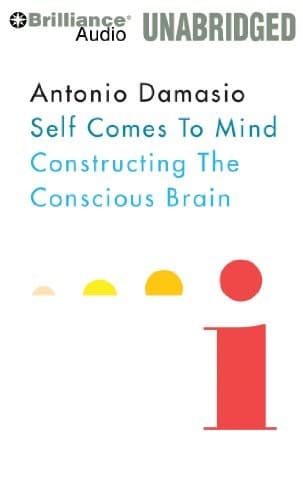
Book details and cover from Google Books.
Ready to read Self Comes to Mind?
Get your copy on Amazon, or listen to it on Audible. We earn a commission if you buy through these links.