
We earn a commission if you buy through these links. Learn more
Scars of independence
by Holger Hoock
Guide by the Books of the Day editors · Updated · How we write our guides
Hoock replaces the tidy founding story with a grim account of the raids, reprisals, and civilian suffering that shaped the American Revolution. A sobering corrective.
What Creators Say About Scars of independence
2 creators reviewed Scars of independence on YouTube between 2021 and 2024, with 208 views between them. Their opinions are their own; we picked these reviews, we didn't write them.
What It's About
Holger Hoock's book argues that the American Revolution was far more violent than the founding story admits. Instead of the orderly, principled struggle often taught in schools and commemorated on monuments, he shows a war of raids, executions, reprisals, and suffering among soldiers and civilians on every side. The central move is to treat violence not as an unfortunate side effect but as a force that shaped the war's outcomes and the meanings people later gave it.
The approach is a broad, narrative-driven survey built on archival evidence from British and American sources. Hoock moves across different regions and across different groups: soldiers, Loyalists, enslaved people, Native nations, and ordinary families caught in the middle. The prose is clear and direct, written for general readers rather than specialists, and the tone is sober rather than sensational.
Reading it is an unsettling but purposeful experience. It asks you to hold two things at once, the high ideals of the Revolution and the brutal conduct that accompanied it, and to see how the gap between them was smoothed over in memory. Most readers come away with a sharper sense of how the war was fought on the ground.
Read this if you…
- want a harder-edged view of the American Revolution than school textbooks offer
- are curious how civilian suffering and wartime violence shaped political outcomes
- enjoy clear, evidence-based narrative history without heavy academic jargon
Skip it if you…
- want a detailed military history of specific battles and commanders
- prefer a celebratory story of the founding and its ideals
Key Ideas
- 1
Violence as a driving force of the war
Hoock treats brutality as central to how the conflict unfolded, not a footnote. Raids, reprisals, and harsh treatment of captives influenced strategy, morale, and the choices civilians made about whose side to be on. Seeing violence as a structural part of the war changes how the military campaigns read.
- 2
Loyalists as victims of revolutionary persecution
The book gives serious attention to people who remained loyal to the Crown and paid heavily for it. Intimidation, property seizure, and mob punishment were common, and these stories complicate the picture of the Revolution as a simple uprising against tyranny. Hoock shows that the new republic's freedoms were built partly on the exclusion of its opponents.
- 3
How memory hides the war's brutality
A central theme is the gap between the war as it was experienced and the version later commemorated. Patriotic storytelling tended to favor heroic battles and founding documents over the grim details of daily conflict. Hoock asks why that happened and what it has cost us in understanding how the nation began.
- 4
Indigenous nations and enslaved people in the conflict
The Revolution was not only a dispute between colonists and Britain. Native nations and enslaved Africans faced violence and difficult choices as the war reached their lands and lives. Including them shows how the conflict spread far beyond the battlefields usually associated with it.
Limitations
Some critics argue the book leans heavily on the grim side of the story, so readers looking for a balanced account of the Revolution's political debates may find it one-sided in emphasis. It is a synthesis of existing scholarship and evidence rather than a major new discovery, and it does not cover the constitutional and political arguments of the period in much depth. Its coverage of some groups, including Native nations and enslaved people, is necessarily broad, so readers wanting deeper treatment should look to specialized works.
Questions Readers Ask
- Is Scars of Independence a good first book on the American Revolution?
- It can be, especially if you already know the basic timeline. The book assumes you can follow a broad historical narrative, and it focuses on violence and civilian experience rather than the full sequence of events. If you are completely new to the period, pairing it with a general overview of the war will help you place the events in context.
- How does it compare with more traditional histories of the Revolution?
- Traditional histories usually center political leaders, campaigns, and founding ideas. Hoock shifts attention to the brutality and everyday suffering that those accounts often treat briefly. Readers who want a fuller picture often read both, using the traditional account for chronology and Hoock to understand what the war meant for people on the ground.
- Published
- 2017
- ISBN
- 9780804137287
- Difficulty
- intermediate
- Category
- History
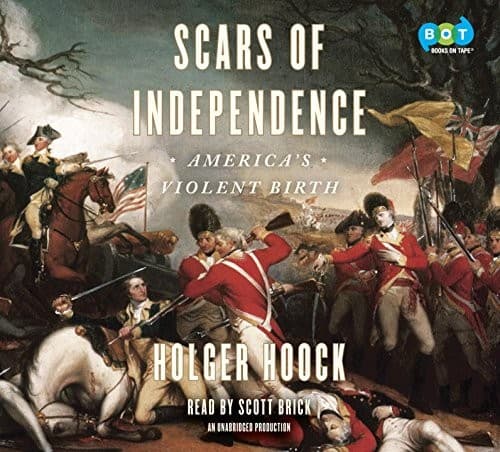
Book details and cover from Google Books.
Ready to read Scars of independence?
Get your copy on Amazon, or listen to it on Audible. We earn a commission if you buy through these links.