
We earn a commission if you buy through these links. Learn more
Scaling Up
A practical operating manual for owners whose companies have outgrown informal management, built around four core decisions and a disciplined meeting rhythm.
What It's About
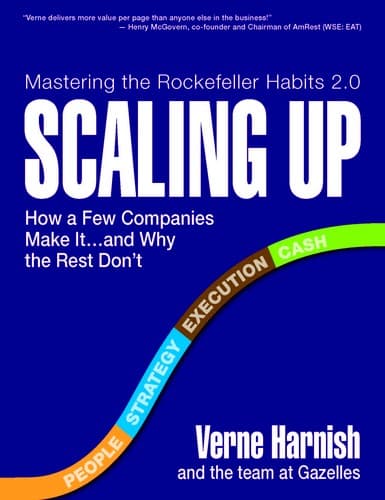
Scaling Up is a practical playbook for founders and leaders whose companies have outgrown the way they were run in the early days. Harnish organizes the problem around four decisions most growing companies must get right: people, strategy, execution, and cash. The book reads more like a working manual than a narrative, with worksheets, meeting formats, and checklists meant to be used rather than simply admired.
Its approach is to turn vague ambitions into a short set of written, measurable commitments that a team reviews on a regular schedule. Much of the material centers on a one-page plan, a shared list of priorities, and a cadence of huddles and reviews that keeps leaders accountable to each other. The tone is brisk and direct, with many small tools rather than long case studies, and the material is aimed mostly at business owners and senior managers.
Reading it feels closer to sitting in on a consultant's workshop than absorbing a single argument. You will likely finish with a list of changes to try and a clearer sense of which routines your company lacks. Expect to skim some sections and return to others when you are actually facing a decision about hiring, planning, or cash.
Read this if you…
- run a company with a leadership team and want a concrete operating system
- prefer checklists, worksheets, and meeting formats to big-picture theory
- are preparing to grow and need to make your team's routines more disciplined
Skip it if you…
- want an in-depth treatment of leadership, company culture, or the human side of growth
- run a very small business or are looking for inspiration rather than step-by-step process
Key Ideas
- 1
Four decisions that drive growth
The book frames scaling around people, strategy, execution, and cash. Harnish treats these as recurring choices a leadership team must keep making, not one-time projects. Each area gets its own set of tools, and the framing helps a team spot which part of the business is actually holding it back at a given moment.
- 2
The one-page strategic plan
A central tool is forcing strategy onto a single page covering the company's purpose, priorities, and measurable goals. The point is brevity: if a plan cannot fit on one page, the team probably has not decided what matters most. Leaders are encouraged to revisit the page regularly rather than filing it away after a retreat.
- 3
A meeting rhythm that enforces follow-through
Scaling Up lays out a schedule of short daily check-ins, weekly meetings, quarterly planning sessions, and an annual review. The idea is that commitments only become real when they are inspected on a predictable timetable. This structure is often the part readers adopt first, because it can be started without restructuring anything else.
- 4
Treating cash as a constraint to manage
Many growing companies look profitable on paper while running short of money. The book gives cash its own decision area, pushing leaders to forecast cash flow, understand what ties up money, and build the habit of checking it. For owners who think of finance as something only the accountant handles, this section can be a useful corrective.
Limitations
The book's main strength is also its main limitation: it is dense with tools, and some readers find the material repetitive or more like a process manual than an argument. Its advice assumes a company with a functioning leadership team and enough scale to justify formal meetings and scorecards, which may feel excessive to a smaller operation. Topics such as culture, ethics, and the personal toll of growth receive less attention than the mechanics do, so readers should look elsewhere for those.
Questions Readers Ask
- Is Scaling Up still relevant for businesses today?
- Much of the core advice about setting priorities, measuring what matters, and holding regular meetings remains useful for companies of many kinds. Some examples and specific tools may feel dated, and digital tools have changed how many teams track their numbers. Treat the frameworks as adaptable templates rather than a fixed script.
- How does Scaling Up compare to Traction by Gino Wickman?
- Both offer an operating system for growing companies with a similar focus on priorities and accountability. Traction is narrower and built around one specific system with its own set of templates. Scaling Up is broader and reads more like a toolkit, covering strategy and cash in more depth, so it suits readers who want options rather than one prescribed method.
- Published
- 2014
- ISBN
- 9780986019555
- Difficulty
- intermediate
- Category
- Business
Book details and cover from Google Books.
Ready to read Scaling Up?
Get your copy on Amazon, or listen to it on Audible. We earn a commission if you buy through these links.