
We earn a commission if you buy through these links. Learn more
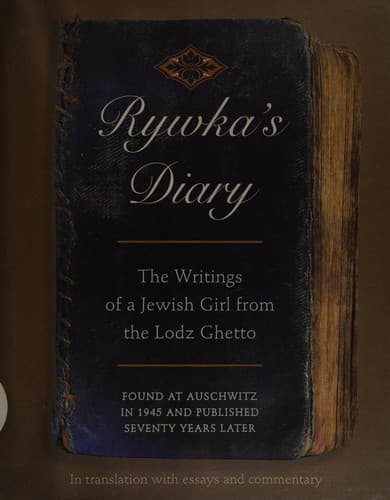
Rywka's diary
A young Jewish girl's wartime diary offers a first-person window onto the Holocaust, read most powerfully as testimony from someone who was there.
What It's About
Rywka's Diary is a personal account of the Holocaust written in the voice of a young Jewish woman who lived through it. Because it is a diary rather than a retrospective memoir, it keeps the immediacy of events as they unfolded, with the uncertainty, fear and small daily routines that the writer could not yet see the end of. Expect short entries whose tone and focus shift as circumstances change, rather than a smoothly structured narrative with a polished arc.
The experience of reading it is quiet and cumulative. Much of the power comes from ordinary detail set against extraordinary danger: what it meant to find food, to keep track of family, to hold on to faith or hope. The writing is plain and direct, and the emotional weight builds through repetition and accumulation rather than dramatic set pieces. A diary like this rarely explains the wider history, so readers new to the period may want a brief outside introduction alongside it.
Approach it as testimony first and literature second. It is best read slowly, a few entries at a time, with the awareness that the author sees only her own corner of events. The fact that these pages exist at all carries weight of its own.
Read this if you…
- are interested in first-person Holocaust testimony and want a young person's perspective
- prefer short, fragmentary writing to a continuous narrative
- want to understand how ordinary people lived through persecution day to day
Skip it if you…
- want a broad historical overview of the Holocaust or its causes
- need a fast-paced story with a clear plot and resolution
Key Ideas
- 1
Testimony written before the outcome was known
A diary captures events as the writer experiences them, without the hindsight that shapes most memoirs. The reader shares the uncertainty of not knowing what comes next, which makes each entry feel provisional and urgent. This immediacy is the book's central feature and the main reason it differs from later reflective accounts of the same period.
- 2
Ordinary routines inside extraordinary danger
Much of the text concerns everyday concerns such as food, shelter, work and staying in contact with loved ones. These mundane details make the persecution feel lived rather than abstract. The contrast between routine and catastrophe shows how people adapted, and how exhausting that adaptation became over time.
- 3
Family, faith and hope under pressure
The diary returns repeatedly to relationships and to the writer's inner life. Her attempts to hold on to belief, to care for others and to imagine a future reveal how emotional bonds and spiritual questions persisted under severe strain. Readers interested in personal resilience will find these threads especially affecting.
- 4
A partial view from one young witness
The author sees only what happens within her own circumstances, so the book offers depth rather than breadth. This limitation is also its strength: it grounds a vast historical catastrophe in a single, specific perspective. Readers should hold this in mind and seek wider sources to place her experience within the larger picture.
Limitations
Because the book is a single diary, it reflects one person's situation and cannot stand in for a comprehensive history. Its fragmentary form can feel disjointed to readers used to conventional narrative, and it offers little explanation of the political forces behind events. Readers encountering it in translation may also lose some of the original voice and nuance. The emotional intensity is considerable, so it may be hard going in long stretches. None of these are flaws in the document itself, but they shape what it can and cannot teach.
Questions Readers Ask
- Is Rywka's Diary suitable for younger readers?
- The prose is plain and accessible, but the subject matter is harrowing, including persecution, loss and fear for family. Many adults find it demanding, so younger readers are best guided by a parent or teacher who can discuss the historical background and help them process what they read.
- How does it compare to Anne Frank's diary?
- Both are wartime diaries by young Jewish writers, so they share immediacy and a personal voice. Anne Frank's account is more reflective and literary, and it is widely taught. Rywka's Diary tends to focus more on the practical struggle of surviving day to day, so readers often read them as companion pieces rather than substitutes.
- Published
- 2015
- ISBN
- 9780062389688
- Difficulty
- beginner
- Category
- Biographies
Book details and cover from Google Books.
Ready to read Rywka's diary?
Get your copy on Amazon, or listen to it on Audible. We earn a commission if you buy through these links.