
We earn a commission if you buy through these links. Learn more
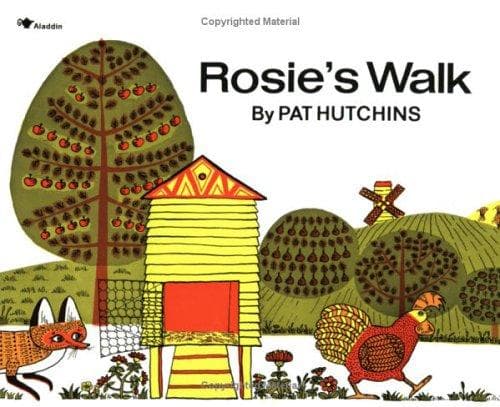
Rosie's walk
by Pat Hutchins
A wordless-feeling picture book where a hen strolls blithely while a fox's schemes fall apart, proving that a story can be built almost entirely from pictures and timing.
What It's About
Rosie's Walk is a picture book by Pat Hutchins, first published in 1968, and it runs to only a few dozen words. Rosie the hen sets off across the farmyard on an errand of pure wandering, while a hungry fox creeps along behind her with clear intentions. The story is carried by the illustrations, which show the fox's plans going wrong at every turn while Rosie carries on, never noticing.
Hutchins builds the joke through a steady, almost mechanical rhythm. Each spread repeats a basic pattern: Rosie moves forward, the fox follows, and something in the setting catches him out. The text stays flat and factual, describing where Rosie goes and saying little more, which leaves the drawings to do the comedy. Readers who look closely will spot the fox in each scene and enjoy tracking how his scheme unravels.
Reading it feels closer to watching a silent slapstick routine than following a conventional narrative. It takes a few minutes and rewards a second and third look. Adults often find it as entertaining as children do, because the gap between what the reader sees and what Rosie knows is the whole engine of the book.
Read this if you…
- enjoy wordless or nearly wordless books where the pictures do most of the work
- want a short, light read that rewards looking closely at each page
- are reading aloud to young children and want a book with built-in repetition
Skip it if you…
- need a story with character development, emotional depth, or an extended plot
- expect a long, substantial read rather than a few minutes of picture-book comedy
Key Ideas
- 1
Dramatic irony as the main engine
The humor depends on the reader knowing something the hen does not. Because Rosie is oblivious, every near-miss lands as a joke instead of a threat. The book trusts you to hold two viewpoints at once and enjoy the distance between them, which is a more sophisticated trick than the simple text suggests.
- 2
Pictures carrying the storytelling
Almost all the narrative information sits in the illustrations. The fox's plan, his mounting frustration, and the consequences of each mishap are shown rather than told. Looking at the background of each spread reveals details that the text never mentions, so the book rewards slow, attentive looking more than quick reading.
- 3
Repetition and predictable rhythm
The structure repeats across the whole book, which makes it easy for very young listeners to anticipate and join in. Repetition also builds tension, since each new spread raises the question of how the fox will fail this time. The pattern is the source of both the comfort and the suspense.
- 4
A small, contained farmyard world
Everything happens within one tidy farm setting, with familiar places and simple objects. That compactness keeps the focus on cause and effect. There are no subplots or wider stakes, so the book feels like a carefully staged piece of physical comedy rather than a story with a broad arc.
Limitations
The book is very slight by design, so readers looking for complexity or lasting emotional resonance may find it thin. Its humor depends on a simple cause-and-effect pattern that some adults will find predictable once they grasp it. The 1968 illustration style is charming but unmistakably of its era, and a few readers may find the farmyard setting and its gentle violence less appealing than more modern picture books.
Questions Readers Ask
- Is Rosie's Walk suitable for very young children?
- Yes. It has very little text, simple sentences, and a clear visual joke that toddlers and preschoolers can follow. The repeated pattern makes it easy to read aloud, and children often enjoy spotting the fox on each page. Older children and adults usually enjoy it too, especially for the timing of the gags.
- Is Rosie's Walk still worth reading today?
- Yes, mainly for its construction. The book shows how much meaning a creator can place in pictures and pacing with very few words. It is a useful example for anyone interested in picture books or visual storytelling, and it still makes most readers laugh, even though the art style feels dated.
What Creators Say About Rosie's walk
Reviews from readers on YouTube. Their opinions are their own.
- Published
- 1967
- ISBN
- 9780020437505
- Difficulty
- beginner
- Category
- Fiction
Book details and cover from Google Books.
Ready to read Rosie's walk?
Get your copy on Amazon, or listen to it on Audible. We earn a commission if you buy through these links.