
We earn a commission if you buy through these links. Learn more
Rosalind Franklin
Guide by the Books of the Day editors · Updated · How we write our guides
A careful, sympathetic corrective to the story of DNA's discovery, restoring the crystallographer whose X-ray images were central to it and whose own life was largely written out.
What Creators Say About Rosalind Franklin
2 creators reviewed Rosalind Franklin on YouTube between 2013 and 2018, with 1.8K views between them. Their opinions are their own; we picked these reviews, we didn't write them.
What It's About
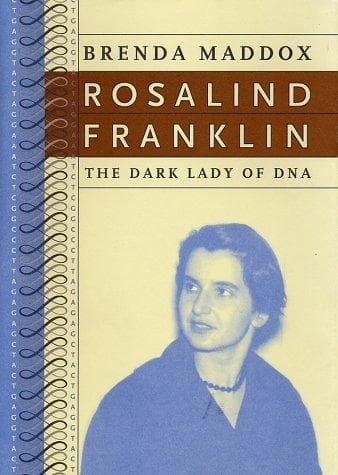
Brenda Maddox's 2002 biography sets out to recover the scientist behind one of the most famous discoveries of the twentieth century. Rosalind Franklin's X-ray diffraction images of DNA were central to the double helix, yet she often appears as a footnote in the account given by James Watson in The Double Helix. Maddox, a journalist and biographer, rebuilds Franklin's life from letters, papers, and interviews with colleagues, friends and relatives.
The book moves chronologically: a London upbringing, Cambridge training in physical chemistry, research on coal and carbon in Paris, and then the crystallography work at King's College London that produced the key photographs. Maddox writes in clear narrative prose, moving between lab detail and personal circumstances while explaining the science without heavy jargon.
Reading it feels more like a corrective than a thriller. Maddox is openly sympathetic and places her subject within the professional and gender dynamics of 1950s science, including strained relations with colleagues. The emotional center is the gap between Franklin's rigor and the limited recognition she received in her lifetime, and her early death from cancer at 37 in 1958.
Read this if you…
- want a clear, humane account of a scientist who was overlooked in the DNA story
- are curious how scientific credit and gender worked in mid-century Britain
- enjoy biography that explains the science without requiring a chemistry background
Skip it if you…
- want a detailed technical account of X-ray crystallography or structural chemistry
- are looking for a neutral, fully balanced history of the rivalries at King's College London
Key Ideas
- 1
Data that others interpret differently
Franklin's diffraction photographs were scientific evidence, but their meaning depended on who was looking and what they were already hoping to find. Maddox shows how the same images could support very different conclusions, and how interpretation can be shaped by rivalry, access and assumptions. The book makes clear that a discovery is a social process as well as a technical one.
- 2
Science as patient, exacting craft
Much of the book is about the slow, unglamorous work of making X-ray diffraction produce usable images. Franklin's reputation rested on technical skill, careful controls and an unwillingness to overstate results. Maddox gives readers a sense of how laboratory method actually works, and why the people who mastered it were so valuable to the field.
- 3
Credit, gender and the mid-century lab
The book examines how a woman scientist in the 1950s was treated by male colleagues, and how that treatment shaped the historical record. Watson's dismissive portrait of Franklin is a recurring reference point. Maddox asks what it meant that the Nobel Prize went to others, and why Franklin's contribution was so easily minimized.
- 4
A divided and displaced working life
Franklin moved between Paris, London and Cambridge-trained habits of mind, and her relationships at King's were often difficult. Maddox treats these tensions as part of the story rather than a side issue. Readers see a scientist who was often moving on to the next problem, and whose personal and professional choices were constrained by her era.
Limitations
Maddox is openly sympathetic to Franklin, and some readers feel the book sets her up as a victim and her male colleagues as villains with less nuance than the evidence allows. Her portrayal of the relationship with Maurice Wilkins is debated. The science is explained for general readers, so those wanting full technical detail will need other sources. Her later work on viruses at Birkbeck gets less space than the DNA years. Because the book dates from 2002, newer archival scholarship may have refined some of its claims.
Questions Readers Ask
- Do I need a science background to read Rosalind Franklin by Brenda Maddox?
- No. Maddox explains X-ray crystallography and the basics of DNA structure in plain language, and the book follows Franklin's life as a story. Some chemistry terms appear, but they are introduced clearly. Readers with no science training can follow the argument, though those who want a deeper technical understanding should pair it with a more specialized text.
- How does this biography compare with The Double Helix?
- They offer very different views of the same events. Watson's memoir is a personal, sometimes unflattering account written from his perspective. Maddox's book is a full biography built around Franklin and her own work. Reading both gives a fuller picture, and it helps to see how one account shaped the way Franklin was remembered for decades.
- Is the book still worth reading today?
- Yes, especially for its portrait of how scientific credit and gender worked in the 1950s. Some of its judgments have been revisited by later historians, so it is best read as a strong and humane account rather than the final word. It remains one of the most readable introductions to Franklin's life and work.
- Published
- 2002
- ISBN
- 9780062283504
- Difficulty
- beginner
- Category
- Biographies
Book details and cover from Google Books.
Ready to read Rosalind Franklin?
Get your copy on Amazon, or listen to it on Audible. We earn a commission if you buy through these links.