
We earn a commission if you buy through these links. Learn more
Rocannon's World
A compact, mythic entry point into Le Guin's Hainish universe, where a lone anthropologist's trek across an alien world becomes a meditation on culture, language, and belonging.
What It's About
Rocannon's World is a short science fiction novel and one of Ursula K. Le Guin's earliest books, set in the Hainish universe, the loosely connected future history she would return to for decades. The story follows Rocannon, a scholar sent to study human populations on a distant planet, after an attack leaves his mission in ruins and forces him to rely on people whose customs and languages he has only begun to understand.
Le Guin writes in a spare, clean style that moves like a quest or an old tale. Much of the pleasure comes from how the setting unfolds. Each society Rocannon meets feels distinct, with its own assumptions about honor, family, and the gods, and the book is more interested in how people make sense of the world than in gadgets or spectacle. The prose is brisk, the scale is intimate, and the mood sits somewhere between an adventure story and a folk legend.
Reading it is a fairly quick experience, and it works best as an introduction to Le Guin's wider concerns rather than as a finished masterpiece. It is a young writer's book in places, with a plot that leans on timely rescues and a hero who is more witness than force of nature. Still, it already shows her habit of using science fiction as a way to examine human difference.
Read this if you…
- enjoy quest stories with a folkloric, mythic feel
- want an early look at Le Guin's Hainish universe
- prefer science fiction that focuses on societies and ideas over gadgetry
Skip it if you…
- need fast-paced plotting with constant twists and reversals
- want the psychological depth and polish of Le Guin's later novels
Key Ideas
- 1
Culture as a lens on difference
The book treats each society as a coherent way of reasoning rather than a backdrop for strange costumes. Rocannon, trained to observe before judging, has to learn that the people he meets have their own logic, and the reader is invited to share that slow, anthropological attention.
- 2
Language as both bridge and barrier
Communication is never simple here. Learning a tongue is presented as a practical survival skill and also as a way of entering another worldview. The story keeps returning to how much meaning gets lost or gained in translation, and how a word can carry a whole history.
- 3
The quest as a structure for worldbuilding
Episodic travel lets Le Guin introduce many settings without long exposition. Each stop reveals another piece of the planet's politics and customs, so the journey itself does the work of building the world and gives the book a steady forward pull.
- 4
Myth-like tone in science fiction
Technology sits quietly in the background, and the emotional register is closer to legend than to hard science fiction. Readers who enjoy older adventure fiction or heroic romance will recognize the rhythms, even as Le Guin quietly questions the heroic model.
Limitations
Readers often note that the characters are sketched more than developed, and Rocannon himself is a fairly passive center for the story. The plot depends on convenient timing and rescues, and some portrayals of women and of the more warlike cultures reflect the assumptions of its era. The sentence rhythms and pacing can also feel old-fashioned to readers used to modern genre fiction. Because it is compact, it explores its world less deeply than the later Hainish novels do.
Questions Readers Ask
- Do I need to read other Hainish books first?
- No. Rocannon's World stands on its own and makes a good starting point for the series. Readers who want more depth can continue with later Hainish novels, which build on the wider universe and its recurring ideas about travel, communication, and cultural difference.
- How does it compare to The Left Hand of Darkness?
- Rocannon's World is shorter, more adventure-driven, and less interior than The Left Hand of Darkness. The later novel is more ambitious in its exploration of gender and politics, while this one is a lighter, more episodic journey that suits readers looking for a quicker introduction.
- Is it still worth reading today?
- Yes, especially if you are interested in how Le Guin developed her approach to culture and worldbuilding. Some of its conventions feel dated, but its curiosity about how people understand one another remains engaging and its brevity makes it an easy read.
- Published
- 1966
- ISBN
- 9780441732968
- Difficulty
- beginner
- Category
- Fiction
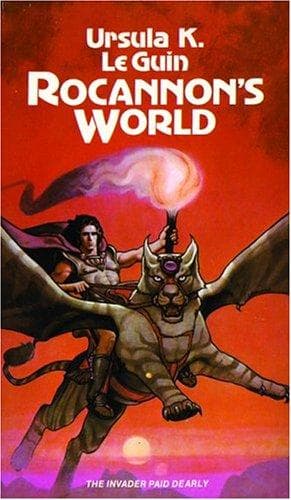
Book details and cover from Google Books.
Ready to read Rocannon's World?
Get your copy on Amazon, or listen to it on Audible. We earn a commission if you buy through these links.