
We earn a commission if you buy through these links. Learn more
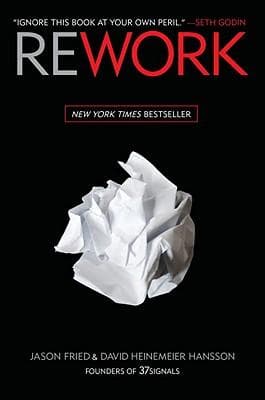
Rework
by Jason Fried, David Heinemeier Hansson
Guide by the Books of the Day editors · Updated · How we write our guides
A short, blunt case for running a small, profitable business by ignoring standard startup advice about planning, funding, and growth, from the founders of 37signals.
What Creators Say About Rework
2 creators reviewed Rework on YouTube between 2015 and 2022, with 16.3K views between them. Their opinions are their own; we picked these reviews, we didn't write them.
What It's About
Rework is a short business book by Jason Fried and David Heinemeier Hansson, co-founders of 37signals, the software company later known as Basecamp. It is built from brief sections rather than long chapters, and each one makes a single argument about how to start and run a company. The tone is direct and deliberately contrarian, aimed at people who suspect that the usual playbook of business plans, venture money, and constant expansion is more habit than necessity.
Reading it feels less like studying a textbook and more like listening to two opinionated operators who have built a profitable company with a small team. The ideas are stated in plain language, often as a sharp one-liner, and the authors lean on their own experience rather than large studies. Because the sections are short, you can finish it in an afternoon and return to individual points when a decision comes up.
The experience is energizing and occasionally irritating. Some points are sharp and immediately practical, while others are broad assertions that you have to test against your own situation. It works best as a provocation that resets your assumptions, not as a complete guide to building a company.
Read this if you…
- run or plan a small business and want a counterweight to standard startup advice
- feel buried in process and want permission to cut meetings and plans
- prefer short, opinionated reads you can finish in one sitting
Skip it if you…
- want a detailed how-to with templates, financial models, or step-by-step frameworks
- run a large company or work in a field where venture-backed growth is the norm and the advice would not translate
Key Ideas
- 1
Start small and stay small
The authors argue against planning big, chasing rapid growth, and raising outside money by default. Small teams make decisions faster, stay closer to their customers, and keep control over what they build. The idea is less about being timid and more about refusing to grow for its own sake.
- 2
Profit gives you more freedom than funding
Rework treats outside investment as a source of pressure that pushes a company toward growth targets it may not need. Bootstrapping, meaning paying for growth out of earnings, forces discipline about spending and keeps the business answerable to customers rather than investors. The case is persuasive, though it assumes your product can earn money early.
- 3
Cut meetings, plans, and busywork
The book suggests that long planning documents, frequent meetings, and layers of process often feel like progress without producing it. Better to make small decisions, act on them, and revisit them later. This is a useful check on overhead for anyone whose calendar is full but whose output is thin.
- 4
Marketing as honest, everyday usefulness
Instead of hype and paid campaigns, the authors favor building something people genuinely recommend to each other. Publicity becomes a byproduct of being useful and talking openly with customers. The advice feels more like a long-term attitude than a tactic you can apply on a schedule.
- 5
Question overwork and rapid hiring
Rework pushes back against the glorification of exhausting hours and the reflex to hire quickly as a company grows. It argues for a sustainable pace and for adding people only when the work truly requires them. These sections are among the most personal and tend to resonate most with readers who are already burning out.
Limitations
The book reflects 2010 and the authors' own web-era software business, so some references to tools, marketing channels, and online work feel dated. Its advice assumes a product that can be profitable with few staff, which may not fit capital-heavy industries, hardware, or heavily regulated fields. Because the sections are deliberately brief, many claims arrive without detailed evidence or nuance. Some critics find the tone glib or self-congratulatory, and the authors do not fully acknowledge how much their success depended on timing and circumstance.
Questions Readers Ask
- Is Rework still relevant today?
- The core attitudes about avoiding overwork, cutting unnecessary process, and staying profitable still hold up well. The specifics about tools, marketing channels, and remote work reflect the authors' time and company, so it is best read as a mindset guide rather than a current tactical manual.
- How does Rework compare to The Lean Startup?
- The Lean Startup by Eric Ries offers a structured method for testing product ideas through experiments and metrics, aimed largely at startups seeking venture funding. Rework is shorter, more opinionated, and focused on attitudes toward money, planning, and growth. Read Lean Startup for process and Rework for perspective.
- Is Rework useful for a solo freelancer?
- Yes, especially for solo operators and small teams, since its points about avoiding overhead and saying no to unnecessary work apply directly. Freelancers may find the hiring and company-building sections less relevant, but the emphasis on protecting your time and staying profitable is highly practical.
- Published
- 2010
- ISBN
- 9781785043024
- Difficulty
- beginner
- Category
- Business
Book details and cover from Google Books.
Ready to read Rework?
Get your copy on Amazon, or listen to it on Audible. We earn a commission if you buy through these links.