
We earn a commission if you buy through these links. Learn more
Relativity
Guide by the Books of the Day editors · Updated · How we write our guides
Einstein explains his own theory in plain language, using thought experiments like trains and falling elevators rather than heavy equations. A rare chance to hear relativity from its author.
What Creators Say About Relativity
2 creators reviewed Relativity on YouTube between 2023 and 2024, with 14.7K views between them. Their opinions are their own; we picked these reviews, we didn't write them.
What It's About
Relativity is Einstein's own short popular account of his theory, first published in German in 1916 and translated into English in 1920. He wrote it for readers without advanced physics training, so it contains few equations. Instead, he works through thought experiments involving moving trains, distant lightning strikes, and a falling elevator to show why our everyday intuitions about space and time break down.
The book moves in two stages. The first part covers special relativity, which deals with objects moving at constant speed and the surprising consequences of the speed of light being the same for every observer. The second part extends the argument to accelerated motion and reinterprets gravity as a feature of the geometry of space and time. The reasoning is verbal and conceptual, so you follow the logic step by step rather than checking calculations.
Reading it feels like listening to a clear teacher at a blackboard. The first half is lively and accessible, while the discussion of gravity asks for more patience and rereading. Because it is a primary source, it has a directness that secondary books rarely match, and it is short enough to finish in a few sittings.
Read this if you…
- want to understand why relativity was needed, not just what its results are
- are curious how a physicist reasons through ideas without relying on formulas
- want to hear the theory explained in its creator's own voice before reading modern texts
Skip it if you…
- need worked equations and calculations to learn physics, since this book has very few
- want an up-to-date survey covering black holes, gravitational waves, and modern cosmology in depth
Key Ideas
- 1
Simultaneity depends on the observer
Einstein shows that two events judged simultaneous from one place may not be simultaneous from a moving place. Whether events happen together depends on the frame of reference, which means time is not the same universal clock everywhere. This is the idea that makes the rest of the theory feel strange, and the book spends real effort making it concrete before moving on.
- 2
The constant speed of light as a starting point
Special relativity rests on two principles: the laws of physics are the same for all uniformly moving observers, and light travels at the same speed for all of them. Einstein treats the second as a striking result that the first principle forces us to accept. Seeing how these assumptions combine is the core intellectual payoff of the first half.
- 3
Gravity and acceleration look identical up close
The equivalence principle observes that someone in a sealed, accelerating room cannot tell acceleration from the pull of gravity. Einstein builds the general theory on this observation and concludes that gravity is better understood as the curvature of space-time than as a force acting across it. This is the most demanding section, and the one where the book's conversational style does the most work.
- 4
What geometry means for physical space
Einstein asks what geometric statements actually say about real rods, clocks, and measurements. He argues that the geometry of the world is an empirical question, not something we can assume in advance. This reframing helps explain why general relativity needed a new mathematical picture of space, and it is useful for readers who have only met geometry as abstract proof.
Limitations
The book was written over a century ago, before many of the experimental confirmations and astrophysical applications that now define general relativity. It says little about the cosmology, black holes, or gravitational waves that dominate current research. Quantum theory, which Einstein himself later struggled with, is outside its scope. Some readers also find the second half abstract, since the book avoids the tensor mathematics needed to compute anything. Its clarity is real, but it gives intuition rather than practical tools.
Questions Readers Ask
- Do I need a physics background to read Relativity?
- No formal background is required, and basic algebra is enough to follow the ideas. The thought experiments carry most of the argument. The general theory section is the hardest part, so expect to reread some passages. Readers who have studied high school physics will find the first half comfortable and the second half rewarding.
- Is Einstein's Relativity still worth reading today?
- Yes, for the core ideas, which remain the foundation of modern physics. Its specific account of cosmology and some experimental details are dated. Many readers pair it with a modern introduction so they can see later developments alongside Einstein's original reasoning and understand how the theory has been tested since.
- Should I read this before a modern popular physics book?
- It depends on your goal. If you want to see the theory from its source, reading Einstein first gives you the original logic. If you want a current overview of black holes and gravitational waves, a modern book will serve you better. Many readers find that reading both in either order gives the most complete picture.
- Published
- 1992
- ISBN
- 9780452287846
- Difficulty
- intermediate
- Category
- Science
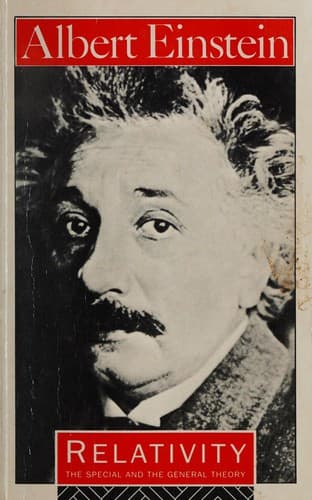
Book details and cover from Google Books.
Ready to read Relativity?
Get your copy on Amazon, or listen to it on Audible. We earn a commission if you buy through these links.