
We earn a commission if you buy through these links. Learn more
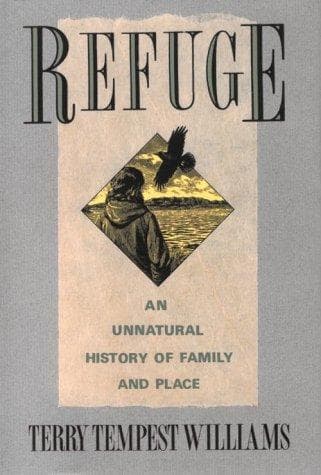
Refuge
Guide by the Books of the Day editors · Updated · How we write our guides
Williams fuses a family's cancer history with the rising waters of a bird refuge into a lyrical, unclassifiable book about grief, witness, and the natural world.
What Creators Say About Refuge
1 creator reviewed Refuge on YouTube in 2020, with 2.1K views between them. Their opinions are their own; we picked these reviews, we didn't write them.
What It's About
Refuge is written as a memoir, but it moves between several registers at once. Williams tells the story of her mother and grandmother, both of whom died of cancer, and connects those deaths to the atmospheric nuclear tests conducted in Nevada during the 1950s and early 1960s. Alongside that family history she follows the changes at the Bear River Migratory Bird Refuge on the shore of the Great Salt Lake, where rising water drowned habitat and displaced birds during the mid-1980s.
The structure is fragmented and associative. Short sections shift between birds, landscape, dreams, and memories, and the chapters often feel more like journal entries or prose poems than a linear narrative. Williams uses repetition and natural-history detail to build an emotional argument rather than a neat one, so the book asks the reader to hold personal loss and ecological loss side by side.
Reading it is slow and immersive. You are less likely to be informed than moved, and the pleasure comes from the sentences and the attention Williams pays to small things. Expect a mood of mourning and watchfulness that stays with you after you finish.
Read this if you…
- are drawn to lyrical nature writing that blends personal memoir with landscape
- want to think about how environmental damage shows up in human lives and families
- can tolerate a fragmented structure and enjoy slow, meditative prose
Skip it if you…
- want a clear, linear narrative or a straightforward account of nuclear testing and its health effects
- prefer nature writing that focuses on field observation and practical ecology rather than personal reflection
Key Ideas
- 1
Family illness as environmental evidence
Williams treats the cancers in her female relatives as a kind of testimony about the land they lived on. She does not present this as a settled scientific finding, but as a personal reckoning with what the fallout from testing might have meant for people downwind. The argument works by making the body a place where environmental history becomes visible.
- 2
Birds as a measure of what is changing
The refuge's birds, and the way their numbers and habits shift as the water rises, give Williams a running record of ecological disruption. She watches closely and reports what she sees without much embellishment. The birds become a way of thinking about attention, belonging, and what it means to lose a home that other creatures still depend on.
- 3
Grief as a form of attention
Much of the book is about the discipline of staying with loss rather than resolving it. Williams returns to the same places and images, and the repetition mirrors how grief actually works. Readers looking for closure or a tidy lesson may find this frustrating, but the refusal to hurry is central to what the book is doing.
- 4
Wildness and the question of what we owe a place
Williams raises, without fully answering, questions about the relationship between a community and the land it inhabits, including the role of the Mormon culture in which she was raised. The book pushes against easy notions of nature as either pristine or simply resource. It suggests that responsibility to a place comes from close, sustained looking and from accepting uncomfortable truths about it.
Limitations
The fragmented, associative form is the book's strength for many readers and its frustration for others. Its claims about the link between family cancers and nuclear fallout are presented through personal experience and are not a rigorous epidemiological argument, so readers wanting firm evidence will need other sources. Some readers find the emotional register heavy or the prose overwrought. The book is also very specific to one region of Utah and to Williams's own family and faith background, so its broader ecological reach depends on how far you connect with that particular place.
Questions Readers Ask
- Is Refuge really history, as its category suggests?
- Not in the usual sense. Refuge is best read as memoir and nature writing with a historical strand about nuclear testing and the regional environment. It does not offer a comprehensive history of either the Nevada tests or the Bear River refuge. If you want a historical account, look for books focused on the fallout program itself.
- How does Refuge compare to Annie Dillard's Pilgrim at Tinker Creek?
- Both are personal, observant books about a particular place, but Dillard's prose is more ecstatic and philosophical, and her attention roams widely. Williams is more rooted in family, grief, and a single threatened landscape. If you liked Dillard's intensity, you may find Williams quieter and more elegiac.
- Is the book still relevant today?
- Yes, especially for readers interested in environmental loss, water and wetlands, and the long-term effects of nuclear weapons testing. Its emotional concerns are timeless. Some of its specifics, such as the 1980s water levels, belong to a particular period, but the questions it raises about place and responsibility still feel current.
- Published
- 1991
- ISBN
- 9780939643462
- Difficulty
- intermediate
- Category
- History
Book details and cover from Google Books.
Ready to read Refuge?
Get your copy on Amazon, or listen to it on Audible. We earn a commission if you buy through these links.