
We earn a commission if you buy through these links. Learn more
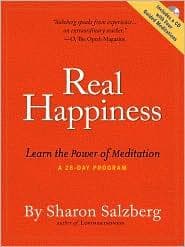
Real Happiness
A warm, structured entry point into meditation that teaches attention and loving-kindness practices you test for yourself over four weeks, without asking you to adopt a belief system.
What It's About
Real Happiness is a practical meditation guide built around a four-week program of short daily sessions. Sharon Salzberg, a longtime teacher in the Insight tradition of Buddhist-derived meditation, presents the methods in largely secular, everyday language. Rather than asking readers to accept a worldview, she invites them to try the practices for themselves and notice what happens over the course of a month.
The book mixes instruction with stories from her own life and from students, along with frank discussion of the obstacles people hit: restlessness, boredom, self-criticism, and discouragement when nothing seems to change. The tone is encouraging and unhurried. Reading it feels like sitting with a patient teacher who expects you to do the work rather than simply absorb the ideas.
The experience works best when read alongside the practice. If you already meditate, many pages will feel gentle and familiar. The real value comes from doing the exercises day by day and paying attention to what shifts in your reactions and relationships. The accompanying guided audio is a meaningful part of the package, so the book suits people who want structure and repetition more than theory or scholarship.
Read this if you…
- want a structured, month-long introduction to meditation
- are curious about Buddhist-based practice without needing to adopt Buddhism
- prefer warm, encouraging guidance to dense theory
Skip it if you…
- want a scholarly account of Buddhist doctrine, history, or texts
- already have an established practice and are looking for advanced instruction
Key Ideas
- 1
Happiness as a trainable skill
Salzberg argues that happiness is not only a fixed personality trait or a product of good fortune. She suggests it can be cultivated through attention and repeated practice, much as any skill improves with regular training. This reframing is the foundation for everything else in the book and gives readers a reason to keep going when progress feels slow.
- 2
Mindfulness as the starting point
The book begins with attention to the breath and to present experience. The aim is to notice thoughts and feelings as they arise instead of being swept along by them. Salzberg presents this steadiness as the groundwork that makes the later practices possible, not as an end in itself.
- 3
Loving-kindness as an active practice
Loving-kindness meditation involves deliberately directing goodwill toward yourself, people you love, strangers, and people you find difficult. Salzberg presents it as a learnable habit that can soften harsh inner dialogue and reduce the reflexive hostility that often shapes daily interactions.
- 4
Treating difficulty as material for practice
Instead of treating restlessness, doubt, or painful emotion as signs of failure, Salzberg encourages readers to work with them directly. This approach reframes hard days as part of the training, which can make the practice feel less like a test you might fail and more like a process you can return to.
- 5
Carrying the practice into ordinary life
The book connects meditation to relationships, work, and small everyday choices. Its emphasis is on how awareness and kindness show up in ordinary moments, rather than on special states achieved during sitting. Readers who want the practice to matter outside their cushion will find this part especially useful.
Limitations
The four-week format is brief and reads more like a well-designed introduction than a complete path, so some readers will want more depth after finishing. Critics sometimes find the upbeat tone and personal anecdotes repetitive or overly reassuring. Its secular framing softens traditional elements of the practice, which some practitioners see as losing important context. The book also does not address the use of meditation for serious mental health conditions, and its claims about happiness are experiential rather than rigorously tested.
Questions Readers Ask
- Do I need to be religious or Buddhist to use this book?
- No. Salzberg presents the methods in largely secular language and draws on Buddhist sources without requiring belief. Readers who want the original religious context will need to look elsewhere, but the practices themselves are accessible to most people regardless of their background or beliefs.
- How does it compare to a standard mindfulness book?
- Many mindfulness books focus mainly on attention and stress reduction. Real Happiness gives equal weight to cultivating kindness, and it is organized as a fixed program with guided audio. If you want a looser, more reflective introduction to attention, Jon Kabat-Zinn's Wherever You Go, There You Are may suit you better.
- Is it still relevant today?
- Yes. The core practices of attention and loving-kindness have not changed much, so the instruction remains usable. Since the book appeared, the mindfulness field has grown and produced more research-focused books, so readers who want current scientific evidence may need to supplement it.
- Published
- 2010
- ISBN
- 9780761159254
- Difficulty
- beginner
- Category
- Meditation
Book details and cover from Google Books.
Ready to read Real Happiness?
Get your copy on Amazon, or listen to it on Audible. We earn a commission if you buy through these links.