
We earn a commission if you buy through these links. Learn more
Raise the Titanic!
Guide by the Books of the Day editors · Updated · How we write our guides
A bold, pulpy Cold War salvage adventure built on an audacious premise, Raise the Titanic! is a fast, escapist read for anyone who wants gadgets, underwater danger, and a hero who never stops moving.
What Creators Say About Raise the Titanic!
2 creators reviewed Raise the Titanic! on YouTube between 2015 and 2026, with 34K views between them. Their opinions are their own; we picked these reviews, we didn't write them.
What It's About
Raise the Titanic! is a 1976 adventure novel by Clive Cussler and one of the best-known entries in his Dirk Pitt series. Pitt works for the National Underwater and Marine Agency, a fictional government body that handles ocean exploration and salvage. The book's premise is deliberately larger than life: the famous 1912 wreck is treated as a site worth recovering, and the reasons for doing so are tied to a scarce mineral with strategic value. Pitt and his colleagues must work against rivals and the clock while the operation grows more dangerous.
Cussler's approach is brisk and cinematic. Scenes move quickly, technical details about diving, ships, and machinery are offered in confident bursts, and the tone leans toward confident heroics rather than psychological depth. The characters are sketched more than developed, and the dialogue often serves the momentum of the plot. The reading experience is closer to watching a big 1970s disaster-and-espionage film than to reading a literary novel: you turn pages because something is always about to go wrong.
If you come to it expecting a precise account of the historical disaster, you will be disappointed. The Titanic serves as a launching point for invention, not documentation. Readers who enjoy the mix of ocean setting, government conspiracy, and can-do problem-solving will find it an easy, entertaining book to finish in a few sittings.
Read this if you…
- you want a fast, escapist adventure with a clear hero and a high-concept premise
- you enjoy 1970s-style disaster and espionage films and their larger-than-life tone
- you like ocean and salvage settings and don't need strict historical accuracy
Skip it if you…
- you want an accurate, carefully researched account of the Titanic's sinking
- you prefer character-driven literary fiction with complex, flawed protagonists
Key Ideas
- 1
A famous wreck as a pulp engine
The Titanic is used less as a historical subject than as a dramatic object that promises wonder and danger. Cussler takes a well-known tragedy and asks what it would look like to treat the wreck as a prize to be won, which gives the book its high-concept appeal and sets the tone for everything that follows.
- 2
Competence as the central pleasure
Pitt is written as a man who can handle nearly any situation, from diving to improvised engineering to tense confrontations. Much of the enjoyment comes from watching him solve problems quickly. The book rewards readers who like capable heroes and clever workarounds more than those who want flaws and doubt.
- 3
Cold War suspicion and strategic resources
The plot draws on the anxieties of its era, where rival powers, secret programs, and scarce materials shape events. These themes give the story its stakes and its sense of hidden competition beneath the ocean surface, though the geopolitics are kept simple and serve the adventure rather than analysis.
- 4
Ocean setting as suspense
The sea is presented as both a frontier and a threat. Cussler uses the depth, darkness, and mechanical difficulty of underwater work to create tension, so the environment matters as much as the human antagonists. Readers interested in maritime settings will find this a major part of the book's texture.
Limitations
The book's biggest weakness is its characterization: Pitt is more a reliable action figure than a fully realized person, and most supporting figures serve the plot. Its treatment of the Titanic is inventive rather than factual, which will frustrate readers who want history. The prose is functional rather than memorable, and the Cold War politics feel dated and simplified by modern standards. Some readers also find the hero's effortless competence repetitive across a long series. None of this is hidden; it is part of the pulp package, and it works best when read as entertainment.
Questions Readers Ask
- Do I need to read the other Dirk Pitt books first?
- No. Raise the Titanic! works as a standalone adventure, and the essential background about Pitt and NUMA is provided as you go. Readers who enjoy it may want to explore the rest of the series, since Pitt's world and recurring characters become more rewarding over time, but you won't be lost starting here.
- Is Raise the Titanic! accurate about the real ship?
- Not in the sense of a historical record. Cussler uses the real 1912 disaster as a foundation, but the rescue plot, technology, and motives are fiction. If you want the actual history of the sinking, a dedicated nonfiction account will serve you far better. This novel is best enjoyed for its invented adventure.
- Published
- 1976
- ISBN
- 9780671667184
- Difficulty
- beginner
- Category
- Fiction
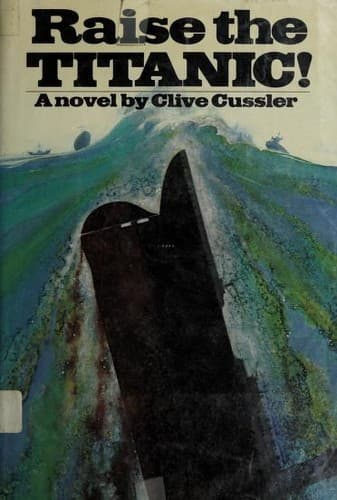
Book details and cover from Google Books.
Ready to read Raise the Titanic!?
Get your copy on Amazon, or listen to it on Audible. We earn a commission if you buy through these links.