
We earn a commission if you buy through these links. Learn more
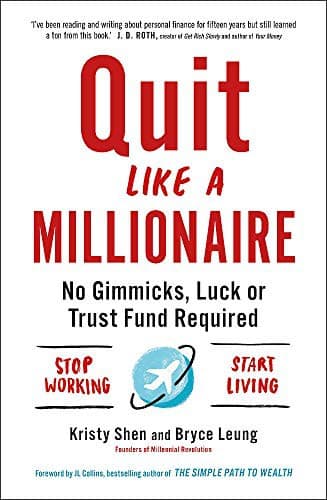
Quit Like a Millionaire
A candid early-retirement playbook from a couple who left full-time work, worth reading for its concrete numbers on spending, saving, and turning savings into income.
What It's About
Quit Like a Millionaire is a personal finance book written by a couple who left full-time work in their early thirties after building a portfolio that could cover their living costs. Kristy Shen and Bryce Leung use their own story as the working example, walking through how they tracked spending, chose where to put savings, and decided what financial independence would actually require of them. The framing is practical rather than inspirational: the core questions are how much you need to invest, at what rate you can safely draw it down, and what trade-offs follow from that.
The reading experience is closer to a sequence of planning exercises than a memoir or a motivational volume. Their voice is direct and occasionally wry, and the numbers are shown rather than hidden, so you can see the assumptions behind their decisions. Much of the material concerns building a savings rate, managing debt, and choosing between index investing and property, with the couple explaining where they took risks and why. Expect to pause and run your own figures rather than simply nodding along.
It works best as a companion to your own planning. Readers who want a complete investing course, or a reliable guide to tax rules in their country, will need other sources. What you get instead is a clear map of one way to think about independence, with enough detail to test it against your own income, obligations and goals.
Read this if you…
- want a concrete, numbers-first plan for leaving full-time work early
- already save seriously and need a framework for turning savings into income
- prefer a candid personal case study to abstract financial theory
Skip it if you…
- expect a comprehensive guide to investing or to tax rules in your country
- find frugal living and early-retirement advocacy uncomfortable or unrealistic on your income
Key Ideas
- 1
Financial independence is a number, not a feeling
The book reduces early retirement to a simple relationship between annual spending and invested capital. Shen and Leung argue that once you know what you spend each year, you can estimate how large a portfolio must be to fund that spending indefinitely. That turns a vague wish to quit into a target you can track, adjust and eventually reach.
- 2
Savings rate matters more than income
Much of the argument rests on the idea that the gap between what you earn and what you spend drives how quickly you can stop working. The authors make the case that trimming recurring costs often does more for your timeline than a raise, because each dollar you do not spend is a dollar you do not have to replace later. The book treats frugality as a deliberate tool rather than a moral virtue.
- 3
Simple, low-cost investing as the default
The authors favour broad, low-cost index funds as the foundation of a portfolio, arguing that most investors are better served by owning the market than by trying to pick winners. They explain the reasoning in plain terms, including why fees compound against you over decades. Readers who already know this material will find the case familiar, but it is made to support the larger goal of living on investment returns.
- 4
Rental property as an income layer
The authors also discuss real estate as a way to generate cash flow alongside their investment accounts. The discussion covers the appeal of rental income, the work and risk that come with being a landlord, and how property fits into an overall plan rather than standing alone. It is one of the more personal and contestable parts of the book, so treat it as one option to weigh rather than a prescription.
- 5
Quitting as an ongoing set of choices
The later sections focus on what happens after the paycheck stops: how to plan spending in retirement, handle uncertainty, and decide whether to keep some form of work. The authors are candid that independence is not a single moment but a series of continuing decisions. This is where the book is most useful for readers who already have a savings habit and want to know what comes next.
Limitations
Much of the book assumes a Canadian context, so tax treatment, account types and registered plans may not transfer to other countries. A fair objection is that the couple's path benefited from a strong income, a high savings rate and a favourable starting point, which many readers will not share. The rental property material carries real risks that the book does not explore in depth. Readers should also check the withdrawal and return assumptions against current market conditions, since early-retirement planning is sensitive to them.
Questions Readers Ask
- Is Quit Like a Millionaire still relevant after recent market changes?
- The core ideas about spending, saving and low-cost investing hold up well because they do not depend on any single market period. Interest rates, property prices and return assumptions have moved since publication, so the numbers in the book are best treated as a starting example. Rerun the math with current figures before making decisions based on it.
- How does it compare to JL Collins' The Simple Path to Wealth?
- Quit Like a Millionaire is more personal and Canadian in context, and it covers the authors' life story and property investing. The Simple Path to Wealth is a leaner, US-focused guide centred on index investing. If you want the investing basics in a short, focused book, Collins is the tighter read.
- Is it worth reading if I am not trying to retire early?
- Yes, if you want to understand how spending choices translate into time and freedom. Many of the savings and budgeting ideas apply to anyone building an emergency fund or saving for a home. The retirement-specific material will matter less, so you can read the early sections closely and skim the rest.
- Published
- 2019
- ISBN
- 9780525538691
- Difficulty
- beginner
- Category
- Finance
Book details and cover from Google Books.
Ready to read Quit Like a Millionaire?
Get your copy on Amazon, or listen to it on Audible. We earn a commission if you buy through these links.