
We earn a commission if you buy through these links. Learn more
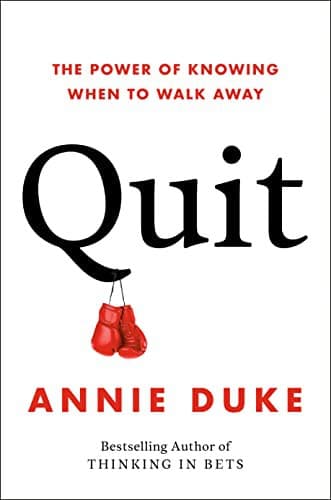
Quit
by Annie Duke
Annie Duke argues that knowing when to stop, switch, or walk away is a learnable skill, and she shows how to build exit rules before emotions take over.
What It's About
Quit is a practical book about a habit most of us were taught to avoid: stopping. Duke, a former professional poker player who now works as a decision strategist, argues that persistence is praised so heavily that people keep investing in failing jobs, stalled projects, and unhelpful relationships long after the evidence says to leave. She treats quitting as a deliberate decision to be made well rather than a character flaw to be hidden.
Her approach draws on everyday examples and on poker-style thinking about probability, separating bad luck from bad choices. The writing is brisk and conversational, with frequent checklists and reframing questions rather than dense theory. You get a clear sense of the mindset she wants you to adopt, along with tools for noticing when your reasons for staying have stopped making sense.
Reading it feels less like being lectured and more like being coached through a series of honest self-checks. It is most rewarding when you are in the middle of a real decision, such as a career move or a project that is draining you, and can test her ideas against your own situation. Because the book is short and direct, it works best as a companion for a specific choice rather than as a deep academic study of decision-making.
Read this if you…
- are weighing whether to leave a job, relationship, or project and want a structured way to think it through
- tend to hang on too long and want practical habits to break that pattern
- enjoy decision-making books grounded in real-world examples rather than academic research
Skip it if you…
- want a rigorous, research-heavy account of decision science with extensive citations
- are looking for a deep, long-form exploration of the psychology of perseverance
Key Ideas
- 1
Quitting is a decision, not a defeat
Duke asks readers to stop seeing a decision to leave as an admission of failure. Quitting is a choice like any other, and it should be judged by whether it improves your future outcomes. Once you see it that way, stopping becomes a tool you can use on purpose instead of something you do only when you are forced to.
- 2
Sunk costs keep us in losing positions
The time, money, and effort you have already spent should not decide what you do next, yet they often do. Duke explains how the pull to justify past investment leads people to double down on bad outcomes. The useful question is what you would choose today if you were starting fresh with the same information.
- 3
Set exit criteria before emotions get involved
A central practical idea is to decide in advance what evidence would tell you to stop. By writing down conditions for leaving before you are invested and attached, you make it harder for hope, pride, or fear to move the goalposts later. This turns a painful judgment call into a rule you already agreed to.
- 4
Separate bad luck from bad choices
Not every poor result means the decision was wrong, and not every good result proves it was right. Duke borrows the habit of judging decisions by the quality of the reasoning behind them, rather than by outcomes alone. This helps you avoid quitting something good after a bad streak, and avoid sticking with something bad because it occasionally works.
Limitations
Critics sometimes find the book repetitive, with the same core message restated across many examples. Its tools are simple by design, so readers hoping for detailed frameworks or quantitative methods may feel underserved. Duke's poker background gives her useful analogies, but it also means some points are filtered through a single lens. The book also does not go deeply into how quitting plays out in areas such as addiction, abusive situations, or mental health, where the stakes and support needs are very different.
Questions Readers Ask
- Who is Quit best suited for?
- Quit suits general readers who are facing a real decision about whether to continue or stop something. It is accessible, with no specialized background needed, and its short chapters and checklists make it easy to pick up. If you are looking for a theoretical account of decision science, you may find it lighter than you hoped.
- How does Quit compare to Thinking in Bets?
- Both books are by Annie Duke and draw on her poker experience. Thinking in Bets focuses on making better decisions under uncertainty in general, while Quit narrows in on the specific challenge of when to stop. If you have already read Thinking in Bets, Quit works as a focused follow-up on one of its most useful applications.
- Is Quit still relevant?
- Yes. The core problem it addresses, staying with things past the point of usefulness, is timeless, and the advice about setting exit criteria in advance remains practical. Some examples may feel dated, but the underlying mental tools apply to careers, projects, and personal commitments today.
- Published
- 2022
- ISBN
- 9781529146165
- Difficulty
- beginner
Book details and cover from Google Books.
Ready to read Quit?
Get your copy on Amazon, or listen to it on Audible. We earn a commission if you buy through these links.