
We earn a commission if you buy through these links. Learn more
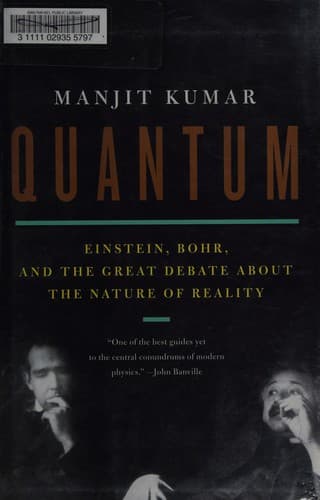
Quantum
by Manjit Kumar
Kumar turns the century's most important scientific argument into a readable story, following Einstein and Bohr as they fought over what quantum theory says about reality.
What It's About
Quantum is a popular history of how physicists built quantum theory in the first three decades of the twentieth century, organized around the long argument between Niels Bohr and Albert Einstein about what the theory says about reality. Kumar moves from Max Planck's 1900 hypothesis through Einstein's work on light, Bohr's model of the atom, and the rapid developments of the 1920s by Heisenberg, Schrödinger, Born and others, with the 1927 Solvay conference as a central set piece.
The approach is narrative and biographical. Kumar spends time on the people: their rivalries, letters, doubts and personal stakes. The science is explained in prose, with analogies and very few equations, so the reader follows the arguments rather than the mathematics. The tone is brisk and sympathetic to both camps, though the Bohr-Einstein clash gets the most room.
The experience is less like a textbook than like a story about a theory that predicts experiments with remarkable accuracy yet still leaves open questions about measurement, probability and what is real. Expect to finish with a clearer sense of why the debate mattered, and why many physicists feel it has never fully been settled.
Read this if you…
- want a human story of the science rather than equations and derivations
- are curious why quantum physics still seems strange even to the people who use it daily
- enjoy intellectual rivalry and want to see how scientists argue about what their results mean
Skip it if you…
- want to learn to calculate with quantum mechanics or work through its mathematics
- want the latest research, since the book stops well before modern quantum experiments and technology
Key Ideas
- 1
Quantum theory began as a reluctant idea
Planck proposed in 1900 that energy comes in discrete packets, and he initially treated this as a mathematical device rather than a claim about nature. The book traces how the idea became physics through Einstein's light quanta and Bohr's atomic model, showing how much the early pioneers were improvising.
- 2
Bohr and Einstein as opposing temperaments
Their disagreement was not only technical. Bohr focused on what experiments can meaningfully say and how language must adapt, while Einstein insisted that a complete physical theory should describe an objective reality that exists independently of observation. Kumar uses their letters and public exchanges to show how the argument developed.
- 3
The 1927 Solvay conference as turning point
The gathering of leading physicists in Brussels became a stage where the new mechanics was presented and fiercely debated. The book uses it to show the field dividing over interpretation, and how some physicists settled into the Copenhagen view while others remained uneasy with it.
- 4
Probability at the heart of physics
Born's reading of the wave function as giving probabilities, and Heisenberg's uncertainty principle, reshaped what physicists expected from a theory. The book explains why this shift troubled many of its founders even though the predictions kept matching experiments.
- 5
Why the argument still matters
The 1935 Einstein, Podolsky and Rosen paper and Bohr's reply framed questions about entanglement and whether quantum mechanics is complete. Kumar shows how these issues remain open for many researchers, which gives the historical story a live edge.
Limitations
Because it was published in 2008, the book does not cover later developments such as the experiments testing Bell's inequalities that were recognized with the 2022 Nobel Prize, or the growth of quantum computing and information science. Its narrative leans heavily on Bohr and Einstein, so other figures and rival interpretations receive less attention. Some readers find the physics thin in places, and the drama is sometimes simplified for a general audience. It is best read as a history of ideas rather than a guide to the science itself.
Questions Readers Ask
- Do I need a physics background to read Quantum?
- No. Kumar avoids most equations and explains concepts in words and analogies, so a general adult reader can follow the story. Some passages on wave functions and the early mathematical formalism need slow reading, and a basic idea of atoms and light helps. Patience matters more than prior training.
- How does Quantum compare to Adam Becker's What Is Real?
- Both cover the Bohr-Einstein debate, but Becker's book, published in 2018, is more openly critical of the Copenhagen interpretation and gives more space to alternative views. Kumar is more purely historical and focused on the people and the 1920s and 1930s. Reading both gives a fuller picture of the debate.
- Is Quantum still relevant today?
- The historical account holds up well, since it covers events from 1900 to the 1930s that are thoroughly documented. The interpretive questions are still debated. However, the book does not cover later experimental work, so pair it with a newer source if you want current developments.
- Published
- 2007
- ISBN
- 9781848311039
- Difficulty
- intermediate
- Category
- History
Book details and cover from Google Books.
Ready to read Quantum?
Get your copy on Amazon, or listen to it on Audible. We earn a commission if you buy through these links.