
We earn a commission if you buy through these links. Learn more
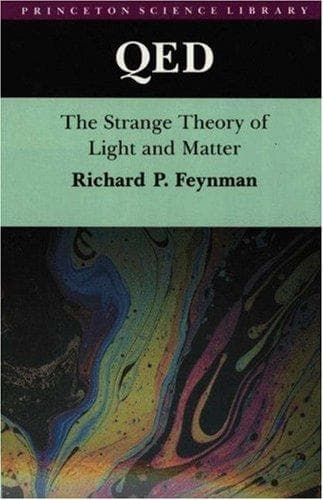
QED
by Richard Phillips Feynman, A. Zee
Guide by the Books of the Day editors · Updated · How we write our guides
A famously clear, equation-light tour of how light and electrons really interact, delivered with Feynman's rare ability to make strange physics feel obvious.
What It's About
QED is a short book built from a set of public lectures Richard Feynman gave in 1983 for a general audience. Its subject is quantum electrodynamics, the theory describing how light and charged particles, mainly electrons, interact. Feynman's aim is not to make you a physicist but to make one strange theory concrete enough that you can see why it works and why physicists trust it. The A. Zee edition adds an introduction by a working theoretical physicist.
The method is a deliberate piece of teaching. Feynman starts from familiar experiences such as reflection in a mirror and light bending as it passes into glass, then gradually swaps everyday intuition for his own bookkeeping: tiny arrows that get added together, with every possible path a photon might take contributing. He avoids most equations, leaning on analogies, asides, and plain admissions of what he does not know. The tone is conversational and often funny, closer to hearing a gifted teacher think out loud than to reading a textbook.
Reading it is quick, but the ideas take patience. The pleasure comes from the moments when a familiar fact about a mirror or a pane of glass suddenly looks odd, and Feynman refuses to let you off the hook. Expect to reread sections and to finish with a changed sense of how physicists think about probability and interaction, rather than with a working calculating skill.
Read this if you…
- are curious about how light really behaves, beyond what school physics suggested
- want a non-mathematical taste of quantum physics from one of its most gifted explainers
- enjoy a lecturer's voice and are happy to think slowly through short passages
Skip it if you…
- need equations and worked calculations to learn physics
- want a modern account of particle physics beyond electrons and photons
Key Ideas
- 1
Light sums over every possible path
Feynman's central move is to treat a photon as if it tries all routes between two points at once. Each route contributes a quantity, and the contributions combine. Most paths cancel out, which is why light appears to travel in straight lines and reflect at equal angles. The idea looks like a trick at first but turns out to explain ordinary optics without special rules.
- 2
Probability as little rotating arrows
Each possible outcome is assigned an arrow whose direction changes as it moves along a path. To find the chance of an event, you add the relevant arrows and square the length of the total. This replaces a lot of mysterious quantum rules with a single visual bookkeeping device, and it is the reason the book keeps returning to arrows.
- 3
Interactions happen in simple, discrete steps
Feynman argues that the basic act of an electron emitting or absorbing a photon is very simple. The complexity people feel in quantum physics comes from combining many such simple steps in every possible order. Once you accept the small basic event, the apparent mess of interactions becomes a matter of counting the ways events can connect.
- 4
Honesty about what the theory cannot explain
A recurring thread is Feynman's refusal to pretend the theory is complete. He points to numbers the theory takes as given, such as the strength of the electron's coupling to light, without explaining where they come from. This candor is part of the book's appeal and gives a useful picture of how working scientists regard their best models.
Limitations
The book covers one theory, the interaction of light and electrons, and does not extend to the wider particle physics that followed, including gauge theories and the Standard Model. Its framing reflects a 1983 audience, so some context is dated. The arrow method is a teaching device that hides much of the underlying mathematics, so it does not prepare you to calculate. Some readers find the jokey, repetitive style tiresome, and Feynman's remarks on the philosophy of science are personal opinion rather than settled doctrine.
Questions Readers Ask
- Do I need a physics or maths background to read QED?
- No formal background is required, and the book avoids most equations. Basic school physics helps, since Feynman refers to familiar experiments like reflection and refraction. The real challenge is conceptual, because the ideas run against everyday intuition, so expect to pause and reread several passages.
- How does QED compare with a quantum mechanics textbook?
- A textbook teaches you to calculate, while this book teaches you to see what the calculations mean. Many readers use it as a companion before or after a textbook rather than as a replacement. It gives you the intuition, but you will need more formal training to solve problems.
- Published
- 1985
- ISBN
- 9780691083889
- Difficulty
- intermediate
- Category
- Science
Book details and cover from Google Books.
Ready to read QED?
Get your copy on Amazon, or listen to it on Audible. We earn a commission if you buy through these links.