
We earn a commission if you buy through these links. Learn more
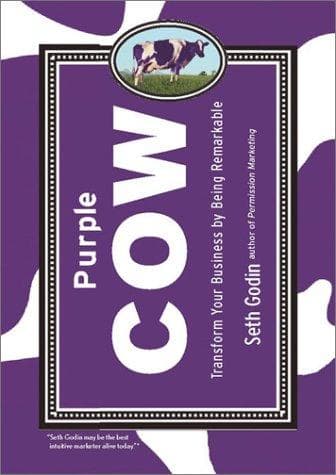
Purple Cow
by Seth Godin
Guide by the Books of the Day editors · Updated · How we write our guides
A short, provocative argument that dull products fail no matter how well they are advertised, and that standing out has to be built into what you make, which makes it a quick, useful jolt for anyone who sells something.
What Creators Say About Purple Cow
2 creators reviewed Purple Cow on YouTube between 2020 and 2023, with 380.2K views between them. Their opinions are their own; we picked these reviews, we didn't write them.
What It's About
Purple Cow is a short business book by Seth Godin, first published in 2003, arguing that most products and marketing campaigns fail for one simple reason: they are unremarkable. Godin's central image is a long drive past a field of brown cows. After the first few, you stop noticing them. A purple cow would be the one you pull over for, and his claim is that in crowded markets, only the remarkable thing gets noticed and talked about.
The book's method is blunt. Godin doesn't build a long case with studies or detailed data. He makes his point, illustrates it with brisk examples, and presses it with plain-spoken advice, often in short, punchy sections that read more like a manifesto or a set of sharp memos to a marketing director. The layout is loose and the pace is fast.
Reading it feels like being pushed to question your default assumptions about safety and caution. It is energizing and quick, often finished in an evening, and it leaves you with a simple test to apply to any product: would anyone bother to mention this to a friend? The tone is confident and sometimes overstated, so the lasting value lies more in the framing than in a tested playbook you can follow step by step.
Read this if you…
- run a small business or side project and want a fast, practical gut check on whether your offer stands out
- work in marketing or product and need an argument to push back against safe, committee-driven decisions
- like short, opinionated business books that you can finish in one sitting
Skip it if you…
- want a detailed, evidence-heavy guide with case studies, data, and step-by-step frameworks
- need a marketing plan for a heavily regulated or commodity industry where differentiation is tightly constrained
Key Ideas
- 1
Playing it safe is the real risk
Godin argues that average, inoffensive products feel safe to make but quietly drift toward invisibility as markets fill up. Blending in means no one has a reason to notice you, so the cautious choice is often the most dangerous one for a business.
- 2
Remarkable means worth talking about
Being remarkable is not just about novelty or shock value. Godin's test is whether people feel compelled to mention the thing to others. That word-of-mouth quality is what makes an idea or product spread without a large advertising budget.
- 3
Target early adopters, not everyone
Mass audiences are fragmented, Godin says, and trying to please everybody usually pleases nobody. He argues that enthusiastic early adopters who talk to their peers matter far more than broad reach, so you should aim your effort at the people most likely to spread the word.
- 4
Build remarkability into the product
Advertising cannot rescue a dull product. Godin's point is that remarkability has to be designed in from the start, across the product itself, its price, and its service. Marketing then becomes a way of amplifying something worth amplifying, rather than a substitute for it.
Limitations
The book leans on assertion more than evidence, and its examples reflect the early 2000s, so some references feel dated. Godin's advice is easier to state than to act on, and it doesn't say much about how to make a truly remarkable product in ordinary, low-margin, or regulated industries. Critics also point out that the book highlights standouts while saying little about the many remarkable products that failed. Treat it as a mindset shift, not a complete method.
Questions Readers Ask
- Is Purple Cow still relevant today?
- Yes, the core idea that crowded markets reward things people actively notice and discuss is still widely relevant. The specific examples and the marketing channels Godin mentions feel dated, so read the book for the argument and bring your own current examples.
- How does Purple Cow compare to Godin's Permission Marketing?
- Permission Marketing focuses on earning consent from customers to communicate with them, while Purple Cow focuses on what you make in the first place. Purple Cow is shorter and more provocative, and it works best as a companion to Godin's earlier, more tactical argument about how to reach people.
- Is Purple Cow useful for a solo creator or small business?
- Often, yes. Its test of whether anyone would bother to mention your product is easy to apply to a freelance service, a newsletter, or a shop. Small operators can act on its advice quickly, though they will need to find their own specific ways to be remarkable.
- Published
- 2002
- ISBN
- 9781101179741
- Difficulty
- beginner
- Category
- Business
Book details and cover from Google Books.
Ready to read Purple Cow?
Get your copy on Amazon, or listen to it on Audible. We earn a commission if you buy through these links.