
We earn a commission if you buy through these links. Learn more
Property
A tight, unsettling first-person novel about a Louisiana planter's wife whose jealousy and sense of ownership make her complicit in cruelty, asking what it means for a woman to be property herself.
What It's About
Property is a short novel narrated by Manon Gaudin, the young wife of a Louisiana sugar planter in the early nineteenth century. Manon is intelligent, restless, and unhappy in a marriage where she has little standing beyond her husband's household. The plantation runs on a system she takes for granted, and the enslaved women who work in her house become the focus of her resentment, especially Sarah, a young woman her husband has taken as his mistress.
Martin's approach is a close first-person voice that is cool, precise, and often unsettling. Manon's account is self-aware in places and self-serving in others, so the reader is left to see more than she does. The book is spare and controlled, driven more by mood and accumulated detail than by plot, and it keeps the pressure on the house, its routines, and the power dynamics inside it.
Reading it is uncomfortable and absorbing. It is less a story of events than a study of how a sense of possession and grievance shapes what a person does, and how the people around her are caught in that logic. Its power comes from the gap between what Manon says and what the reader sees.
Read this if you…
- want a compact, character-driven novel about power inside a household
- are interested in how historical fiction can examine complicity from the inside
- enjoy unreliable narrators whose self-justifications slowly come apart
Skip it if you…
- need the enslaved characters to have their own central point of view
- are looking for a fast-moving plot with clear heroes and resolution
Key Ideas
- 1
Marriage as a form of ownership
Manon discovers that her own position is defined by property law and social convention. She is not a free agent in her marriage, and the novel draws a sharp parallel between her status and that of the enslaved people around her. The book asks how someone who is herself dependent can still take part in owning others.
- 2
An unreliable, self-justifying narrator
Manon presents her choices as reasonable responses to her husband's behavior and her own unhappiness. Martin lets her voice carry the reader along while leaving room to notice what she refuses to see. Much of the book's tension lives in that distance between her version of events and the truth of them.
- 3
Jealousy as the engine of cruelty
Rather than depicting slavery as an abstract system, the novel shows how private feelings of rivalry and humiliation translate into harm within a household. Manon's jealousy toward Sarah becomes the lens through which the reader sees daily violence. The emotional logic feels intimate and therefore disturbing.
- 4
A cool, observant prose style
Martin writes in a restrained, precise register that rarely raises its voice. The calm surface makes the cruelty more chilling, not less. Readers who want lush historical description or dramatic set pieces may find the book quieter than expected.
- 5
Perspective centered on the white mistress
The novel is built around Manon's point of view, so the inner lives of the enslaved characters are visible mainly through her eyes. This is a deliberate choice that shapes the book's moral focus. It is worth noticing what the structure reveals and what it withholds.
Limitations
Some readers find the narrow focus frustrating. Because the story is filtered entirely through Manon, the enslaved women remain less fully realized than they might be in a novel that gave them their own voices. The prose is deliberately restrained, which can feel slow or emotionally distant to readers who prefer warmth or momentum. The book also works within the conventions of literary fiction about the American South, so those who want a fresh historical framing may find it familiar in its concerns.
Questions Readers Ask
- Is Property hard to read because of its subject?
- The subject is harsh, and the novel does not soften slavery or its violence. The prose itself is clear and not technically demanding, though the emotional weight is considerable. Readers who handle difficult historical fiction should find it manageable. It is short enough to read in a few sittings.
- How does Property compare to other novels about slavery?
- Property is narrower and more psychological than many well-known novels on the subject. It focuses on a white woman's perspective rather than giving the enslaved characters their own central voices. Readers looking for the inner lives of the enslaved people may want to pair it with novels that center them directly.
- Published
- 2002
- ISBN
- 9780385504089
- Difficulty
- intermediate
- Category
- Fiction
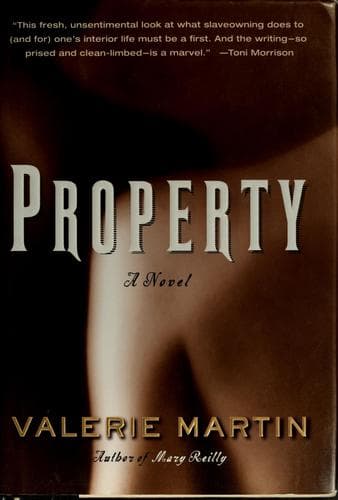
Book details and cover from Google Books.
Ready to read Property?
Get your copy on Amazon, or listen to it on Audible. We earn a commission if you buy through these links.