
We earn a commission if you buy through these links. Learn more
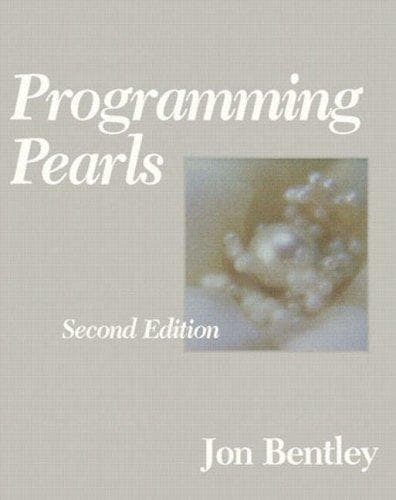
Programming Pearls
by Jon Bentley
A short, playful tour of how experienced programmers think about problems, using small case studies on sorting, searching, and efficiency that still reward a working developer decades later.
What It's About
Programming Pearls is a collection of essays drawn from Jon Bentley's column in Communications of the ACM, reworked into a book. Each chapter starts from a concrete problem, often one that sounds simple, and works through several attempts toward a solution that is faster, smaller, or more reliable. The problems matter as much as the answers: you watch a rough first idea get refined, tested, and sometimes thrown out.
The style is conversational and a little mischievous. Bentley writes like a colleague at a whiteboard, mixing code, back-of-the-envelope arithmetic, and asides about how real projects went wrong. Much of the code is in C, and the exercises that close many columns invite you to keep going. The chapters are short enough to read one at a time, but they reward slowing down and rewriting the programs yourself.
Reading it feels less like studying a textbook and more like overhearing an expert think out loud. You will finish with fewer tricks than you might hope for and more habits of mind: estimating resources before coding, checking your assumptions, and asking whether a problem can be shrunk before you make the program cleverer.
Read this if you…
- want to become a better programmer rather than learn a new language or framework
- enjoy small puzzles and like seeing a problem improved step by step
- write code where speed or memory use really matters and want to reason about it
Skip it if you…
- need up-to-date coverage of modern languages, frameworks, or web development
- want a complete reference or textbook covering every major algorithm
Key Ideas
- 1
Estimate costs before writing any code
Bentley repeatedly does rough arithmetic on time and memory before committing to a design. The habit is to ask how much space and work a solution will really need, which often rules out whole families of approaches in seconds. This kind of quick estimation is a skill that transfers directly to modern systems, even though the specific numbers have changed.
- 2
Representation can beat raw cleverness
Several chapters show that choosing the right way to store data can simplify an algorithm or cut its memory use dramatically. A compact bit-based structure, for example, can handle a job that looks too big for the available memory. The lesson is to look at how information is laid out before tuning the code that operates on it.
- 3
Small algorithms are easy to get wrong
Bentley uses familiar routines such as binary search to show how even short, well-known code can hide subtle errors at its boundaries. He treats correctness as something to argue for carefully, not something you assume. The chapters train you to reason about invariants and edge cases rather than trusting a memorized pattern.
- 4
Refine a solution step by step
The book models a working style of starting with a clear but naive version and improving it in stages, measuring as you go. Each refinement is motivated by a specific bottleneck or requirement. Seeing this process repeated across different problems makes it easier to apply to your own work.
Limitations
The code and hardware assumptions reflect an earlier era, so some details about memory, performance, and tooling no longer match current systems. The book does not cover concurrency, distributed systems, testing frameworks, or version control in any depth. Some readers find the chatty tone charming, while others wish for fuller derivations or more systematic coverage. Treat it as a source of problem-solving habits rather than a manual for building modern software.
Questions Readers Ask
- Is Programming Pearls still relevant today?
- The specific hardware constraints and language choices are dated, but the habits it teaches do not age. Estimating costs, shrinking a problem before optimizing it, and verifying small algorithms carefully are as useful now as they were. Read it for the thinking rather than for current syntax or tooling advice.
- Do I need to know C to get value from it?
- Familiarity with C or a similar language helps, especially for the longer programs. The code is short, though, and the reasoning matters more than the syntax. Many working programmers in other languages read it comfortably, skimming the details and focusing on the arguments and trade-offs.
- How does it compare to Code Complete?
- Code Complete is broader and more comprehensive, covering much of software construction as a discipline. Programming Pearls is shorter and more focused, built around case studies of solving specific problems well. Many readers enjoy both, using Pearls for problem-solving intuition and the other for the wider practice of building software.
- Published
- 1999
- ISBN
- 9780201657883
- Difficulty
- intermediate
- Category
- Tech
Book details and cover from Google Books.
Ready to read Programming Pearls?
Get your copy on Amazon, or listen to it on Audible. We earn a commission if you buy through these links.