
We earn a commission if you buy through these links. Learn more
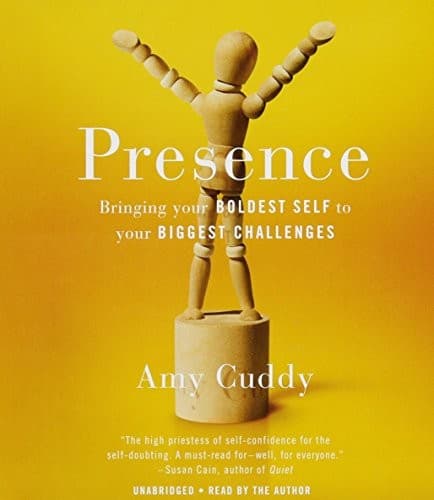
Presence
by Amy Cuddy
Amy Cuddy's Presence offers a warm, practical take on feeling like yourself under pressure, and it is most useful if you read its power posing claims as a confidence aid rather than established science.
What It's About
Presence is Amy Cuddy's 2015 follow-up to the TED talk that made her name. It is about the moments when you feel least able to show up as yourself: job interviews, hard conversations, high-stakes presentations, or a setback that shakes your sense of who you are. Cuddy, a social psychologist, argues that the key to acting well under pressure is not performing confidence but feeling connected to your values and your genuine self, and she frames that state as presence.
The book mixes personal storytelling, including her own experience of a serious setback, with summaries of psychology research and practical exercises. Chapters move through ideas rather than following a single narrative, and the tone is warm, encouraging, and conversational, closer to a coach talking than to a textbook. Each idea comes with suggested practices meant to be tried in real situations.
Reading it feels like sitting with a motivated, somewhat self-disclosing guide who wants you to feel steadier and more open. It is quick to read, and most of its value lies in the framing and the habits it suggests. Readers who want dense citations, or a rigorous account of which claims hold up, will find it thinner than its confident tone suggests.
Read this if you…
- you freeze or overthink during interviews, presentations, or hard conversations
- you want a short, encouraging book about confidence and authenticity rather than a dense research summary
- you are rebuilding after a setback and want practical ways to reconnect with your sense of self
Skip it if you…
- you want rigorous, well-cited science and a clear account of which claims have held up
- you dislike self-help books that rely heavily on personal anecdotes and motivational tone
Key Ideas
- 1
Presence as a state, not a personality trait
Cuddy describes presence as a momentary condition in which you are attentive to the present and connected to what matters to you, rather than something only certain people are born with. The practical upshot is that you can cultivate it, notice when you have lost it, and return to it deliberately in the middle of a difficult moment.
- 2
Feeling authentic when you are being judged
A recurring idea is that under evaluation, people fixate on how they appear, which drains attention and makes them seem stiff or defensive. Cuddy argues that anchoring yourself to your values and strengths helps you stay engaged with the people and task in front of you instead of monitoring your own performance.
- 3
Power posing and its contested evidence
She revisits the idea from her famous talk that expansive body postures can change how you feel and how others see you. The feeling-based benefits are easier to defend than the claimed hormonal changes, which later researchers failed to reproduce and which some of the original team questioned. Treat it as a confidence habit, not a proven biological fix.
- 4
Reframing nervousness as readiness
Cuddy suggests that the physical signs of anxiety can be read as energy that prepares you to perform rather than as proof you are failing. Combined with short self-affirming routines before stressful events, this reinterpretation is meant to reduce the mental noise that pulls attention away from the task.
Limitations
Presence leans heavily on Cuddy's own studies and personal stories, and some of the book's most visible claims, especially about power posing, have failed to replicate in later research. Critics have also found the advice general and sometimes repetitive, with less guidance on the structural pressures that shape who gets judged harshly in the first place. The book does not offer a deep treatment of workplace inequality, and its examples lean toward professional and academic settings. Read it as a set of encouraging frameworks rather than settled science.
Questions Readers Ask
- Is the power posing advice still worth trying?
- Yes, if you treat it as a low-cost way to feel more grounded before a stressful event. The evidence for the hormone changes Cuddy originally described is weak, and later replication attempts did not confirm them. The self-reported feelings of confidence are the more defensible part of the claim, so consider it a ritual rather than a scientific intervention.
- How does Presence compare to Brené Brown's Daring Greatly?
- Both address vulnerability and self-worth under pressure, but Brown's book is broader and more grounded in a long qualitative research program on shame and courage. Presence is narrower and more focused on in-the-moment performance and self-presentation. If you want a deeper account of why we hide, Brown is the stronger choice; if you want quick techniques for a specific situation, Cuddy is more direct.
- Published
- 2015
- ISBN
- 9780316256582
- Difficulty
- beginner
- Category
- Self-Improvement
Book details and cover from Google Books.
Ready to read Presence?
Get your copy on Amazon, or listen to it on Audible. We earn a commission if you buy through these links.