
We earn a commission if you buy through these links. Learn more
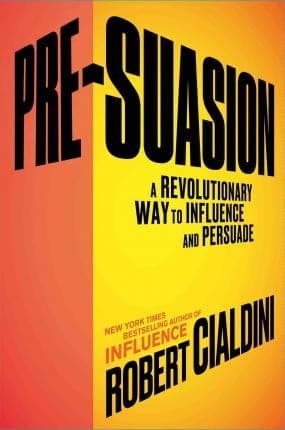
Pre-Suasion
by Robert B. Cialdini, John Bedford Lloyd
Cialdini's follow-up to Influence argues that the moments before a persuasive message shape how it lands, and shows how to use that window ethically and deliberately.
What It's About
Pre-Suasion is Robert Cialdini's follow-up to Influence, the book that made his six principles of persuasion famous. Written with John Bedford Lloyd, it shifts attention from the message itself to the stretch of time before anyone hears it. Cialdini's central claim is that whatever a person is attending to, feeling, or associating with in the moments before a request determines how that request is received, often more than the request's content does.
The book is organized around the idea of a "privileged moment" that a communicator can influence, and it draws on a long run of social psychology research and anecdotes to make the case. The tone is that of a practical guide rather than a dense academic text: short sections, plenty of examples from marketing, politics, and everyday negotiation, and a steady focus on what a reader can actually do before the next pitch, meeting, or ask.
Reading it feels like being shown the machinery behind a familiar experience. Many readers will recognize their own reactions in the examples, and the book works best as a lens for noticing how others prepare their audiences. It rewards slow reading and pairs well with Influence, though it stands on its own. It is less a set of rules than a way of thinking about sequence and setting.
Read this if you…
- want a practical account of how framing and sequence affect decisions
- work in sales, marketing, teaching, or any job that involves asking people for things
- liked Influence and want to see where Cialdini's thinking went next
Skip it if you…
- expect a rigorous, citation-heavy academic treatment with every claim tested in detail
- are looking for a deep dive into the research behind each example, since the book prioritizes readability over exhaustive evidence
Key Ideas
- 1
Attention is where persuasion begins
Cialdini argues that people tend to treat whatever is in focus as important. The first job of a communicator, on this view, is to direct attention toward the right features before asking for anything, because whatever draws the eye tends to get weighted more heavily in the decision that follows.
- 2
Association shapes what people feel
Ideas and feelings linger after they are encountered and carry over into unrelated judgments. Setting the context beforehand can therefore steer a response without changing the argument itself, which is why the surroundings of a request can matter as much as its wording.
- 3
The privileged moment before the message
The window just before a request is when an audience is most open to being moved. The book treats this stretch as something a communicator can deliberately prepare and design, rather than a passive gap between the setup and the pitch.
- 4
Shared identity as a setup
People respond more readily to those they see as part of their own group. Establishing common ground in advance can make later requests land more easily, and the book explores how small signals of similarity can open doors before any formal argument is made.
- 5
Whether these tactics are fair
Cialdini returns repeatedly to the ethics of deliberate influence. The same techniques can manipulate or help, and he frames the difference around whether the outcome serves both sides. Readers who care about this question will find it kept in view throughout.
Limitations
Some of the research the book leans on comes from studies in the priming and framing literature, and parts of that field have had well-publicized difficulty reproducing results. The book is more persuasive in tone than rigorous in detail, and many examples are anecdotal or illustrative rather than systematically tested. Readers looking for the strength of each effect, or for the boundaries where these ideas fail, will need to look elsewhere. The book also spends less time on the practical limits of these tactics than its ethical framing might suggest.
Questions Readers Ask
- Do I need to read Influence before Pre-Suasion?
- No. Pre-Suasion is written to stand on its own, though it builds on Cialdini's earlier ideas. Readers who already know Influence will recognize some themes and may appreciate seeing how the thinking developed. Newcomers can start here and still follow the argument without difficulty.
- Is Pre-Suasion still relevant given problems in priming research?
- Some of its specific claims rest on research that has been harder to reproduce than once assumed, so it is wise to hold individual examples loosely. The broader idea that context and attention shape judgment remains widely discussed. Treat the book as a framework for noticing how audiences are prepared, not as a set of guaranteed effects.
- How does it compare to Influence?
- Influence focuses on the six principles that drive compliance. Pre-Suasion moves the spotlight earlier, to the moments before a request is made. If you want a foundation of persuasion principles, start with Influence. If you want to understand setup and sequencing, Pre-Suasion is the natural next step.
- Published
- 2016
- ISBN
- 9781501109812
- Difficulty
- beginner
- Category
- Psychology
Book details and cover from Google Books.
Ready to read Pre-Suasion?
Get your copy on Amazon, or listen to it on Audible. We earn a commission if you buy through these links.