
We earn a commission if you buy through these links. Learn more
Postmortem
Postmortem introduces Dr. Kay Scarpetta and a serial killer hunt driven by autopsies and forensic evidence, offering a grounded, insider's look at death investigation.
What It's About
Postmortem is set in Richmond, Virginia, where Dr. Kay Scarpetta, the city's chief medical examiner, is handling a run of violent deaths when a series of killings starts to look like the work of one person. The book is narrated by Scarpetta herself, so the investigation comes through the eyes of someone who spends her working life with the dead and then has to explain them to the living. Rather than building suspense mainly through chases, Cornwell builds it through autopsies, lab work, and the careful reading of what bodies and evidence can reveal.
The experience is methodical and procedural. You get a lot of concrete detail about how a medical examiner's office runs, how bodies are examined and documented, and how forensic material moves through a case. Scarpetta also works in a department and a city where she is an outsider in several ways, and the friction with colleagues and police is part of the texture. The prose is clipped and direct, with a clinical edge that some readers find gripping and others find cold.
Expect a thriller that cares more about process and character than puzzle-box twists. The narrator's personal life gets real room on the page, and the book feels very much of its moment in its professional setting and pacing. It works best if you want to watch a capable, tightly focused professional at work.
Read this if you…
- enjoy procedural crime fiction where the investigation is driven by forensic detail
- want to start a long-running series with a consistent first-person narrator
- are curious how forensic medicine shaped the modern crime novel
Skip it if you…
- want fast action, chases, or a twisty puzzle with constant reveals
- find graphic descriptions of bodies and violence hard to stomach
Key Ideas
- 1
The autopsy as an investigative tool
The book treats the body as a document. Scarpetta's work is about reading injuries, timelines, and physical traces closely enough to say what happened and to whom. That makes the medical examination itself the main engine of the plot, rather than a backdrop to a detective's legwork.
- 2
Forensic science driving the case
Scientific testing, including early attention to DNA-style evidence, shapes what investigators can prove and what they cannot. The tension often comes from waiting on results, interpreting them, and deciding whether the lab can be trusted. Readers who like seeing how evidence gets built will find this the most satisfying layer.
- 3
Authority and gender in a male-dominated system
Scarpetta has to earn respect from police, political figures, and colleagues who doubt her judgment. The book is frank about the cost of being the person in the room who must be right. This thread gives the procedural material a personal stake without turning the story into a simple courtroom drama.
- 4
Public duty and private life
Scarpetta's job takes over her time, her relationships, and her sense of self. The novel keeps returning to what she gives up to do the work well. That emotional cost is a steady counterweight to the grim facts of each case and is a reason the series has lasted.
Limitations
Postmortem is from 1990, so its technology, pacing, and assumptions about investigation feel dated to many modern readers, especially where science and databases are concerned. Some critics find the prose mannered and the heroine close to idealized, and the serial killer framework follows conventions that later thrillers have pushed further. The gore is detailed and unflinching, which some readers will see as essential realism and others as sensationalism. The book also leaves much of the wider Richmond world thinly sketched, so the picture of the city and its politics is partial.
Questions Readers Ask
- Do I need to read the Scarpetta series in order?
- Postmortem is the first Kay Scarpetta novel and it works as a standalone case. Reading in order does help with the recurring characters, especially the detective Marino and Scarpetta's personal circumstances, which develop across the books. If you only want one standalone mystery, this one is complete, but you will get more out of the series by starting here.
- How does it compare with The Silence of the Lambs?
- Both books draw on forensic and investigative expertise and feature a serial killer, but Postmortem is more procedural and less psychologically intimate. Where Harris focuses on the relationship between investigator and killer, Cornwell spends more time on autopsies, lab work, and institutional politics. Readers who liked the forensic side of Harris's book will likely find this familiar terrain.
- Published
- 1990
- ISBN
- 9780745164823
- Difficulty
- beginner
- Category
- Fiction
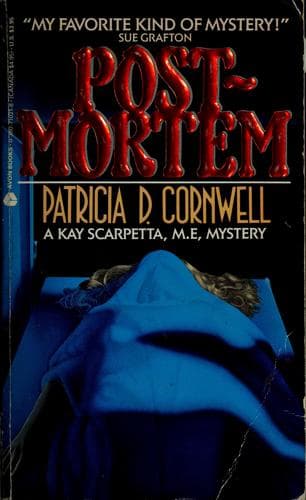
Book details and cover from Google Books.
Ready to read Postmortem?
Get your copy on Amazon, or listen to it on Audible. We earn a commission if you buy through these links.